
Radio For Beginners
The Electromagnetic Spectrum
The electromagnetic (EM) spectrum is a spectrum on which all types of radiation or electromagnetic energy lie. This energy travels in waves which can range from the very small wavelengths of gamma rays at 0.001 nanometers (around the size of an atom) to radio waves with wavelengths of hundreds of meters.
We use or are exposed to parts of the electromagnetic spectrum every day. In the middle of the spectrum we have visible light, everything that we see is due to this tiny section of the spectrum. Waves with smaller wavelengths are classed as ionizing radiation, such as ultraviolet (UV) from the Sun, X-rays which we use to see our bones, and Gamma rays that are made in nuclear reactions. These types of EM radiation are dangerous in large quantities as they have enough energy to remove electrons from atoms (see our plasma physics tutorial series).
On the other side of the spectrum we have longer wavelengths which are not harmful to humans. Infrared radiation is what toasts your bread in a toaster, microwaves have a special wavelength that heats up water so we can use them to heat our food. But what we here at SuperDARN use and many scientists all over the world use for various discoveries, is radio waves.
Radio waves are waves with the longest wavelength, on the right of the image below. Radio waves revolutionized how humans communicate with one another across the world, allowing for messages to be sent to far off locations almost instantly. Today, the most common use is in your car radio, but astronomers and space scientists use them to understand more about the universe around us.
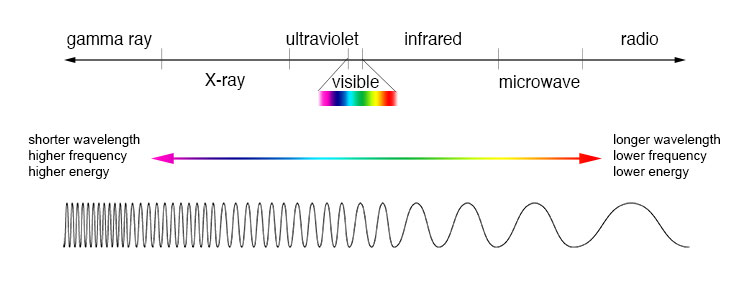
Comparison of wavelength, frequency and energy for the electromagnetic spectrum. Credit: NASA's Imagine the Universe
Frequency, Amplitude and Wavelength
For this section, we will discuss different characteristics of waves using the example of a surfer waiting to catch a wave on the ocean. The wave on the ocean is similar to our electromagnetic wave, and the surfer is a point in space that the wave is moving through. As the waves come and pass, the surfer bobs up and down in the water. If we count how many times the surfer bobs up and down in a given time frame, we are calculating the frequency of the ocean waves. If waves begin to move faster towards the shore, the surfer will bob up and down more often, and hence the surfer will have a higher frequency. Scientists measure frequency in Hertz which is how many times per second the wave goes up and down.
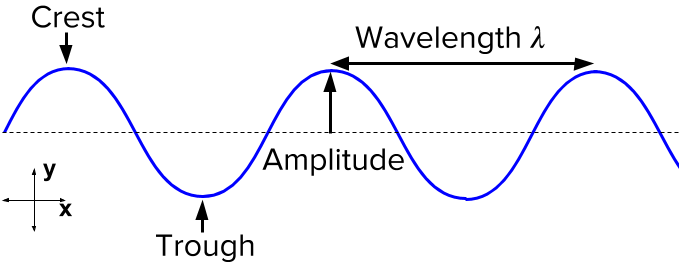
Parts of a wave. Credit: KhanAcademy
Our surfer is still waiting for their perfect wave. But they want it to be a big wave. As the surfer bobs up and down, they can measure the Amplitude of the wave by measuring how far they move up and down from the crest of a wave to the trough. Scientists measure this distance in meters, and is usually the distance up and down between the central point (halfway up a wave) to the top of a crest. This can be seen in the diagram above.
Wavelength is also measured in meters, and measures the distance between two wave crests along the wave. The frequency of the wave, or how quickly our surfer is bobbing up and down, and the wavelength are related. If the waves are moving faster past our surfer, but the distance between each wave is the same, then our surfer will bob up and down quicker. If we consider a wave of the EM spectrum, all these waves have a fixed speed, the speed of light, which we call c. Then the frequency and wavelength of our radio waves are always fixed in the relationship: wavelength x frequency = speed of light!
Each color you can see from red to violet has it's own wavelength which makes it that color. With the exception of magenta. Magenta is made up in our brains to fill the gap between red and violet on the color wheel.
Generating Radio Waves
If we take a normal wire which we use to conduct electricity, we can generate an EM wave by varying the electric current that flows through the wire. Either by turning it on and off or by reversing the current backwards and forwards. We can match the type of wave that we want (we want radio waves), by reversing the current at the same frequency as that type of wave.
Now if we imagine this wire is a very tall radio transmitter, the exact type with which you see on top of radio stations. The electrons in the transmitter tower wiggle backwards and forwards along the tower, and as they speed up and slow down they produce radio waves which propagate outwards from the tower.
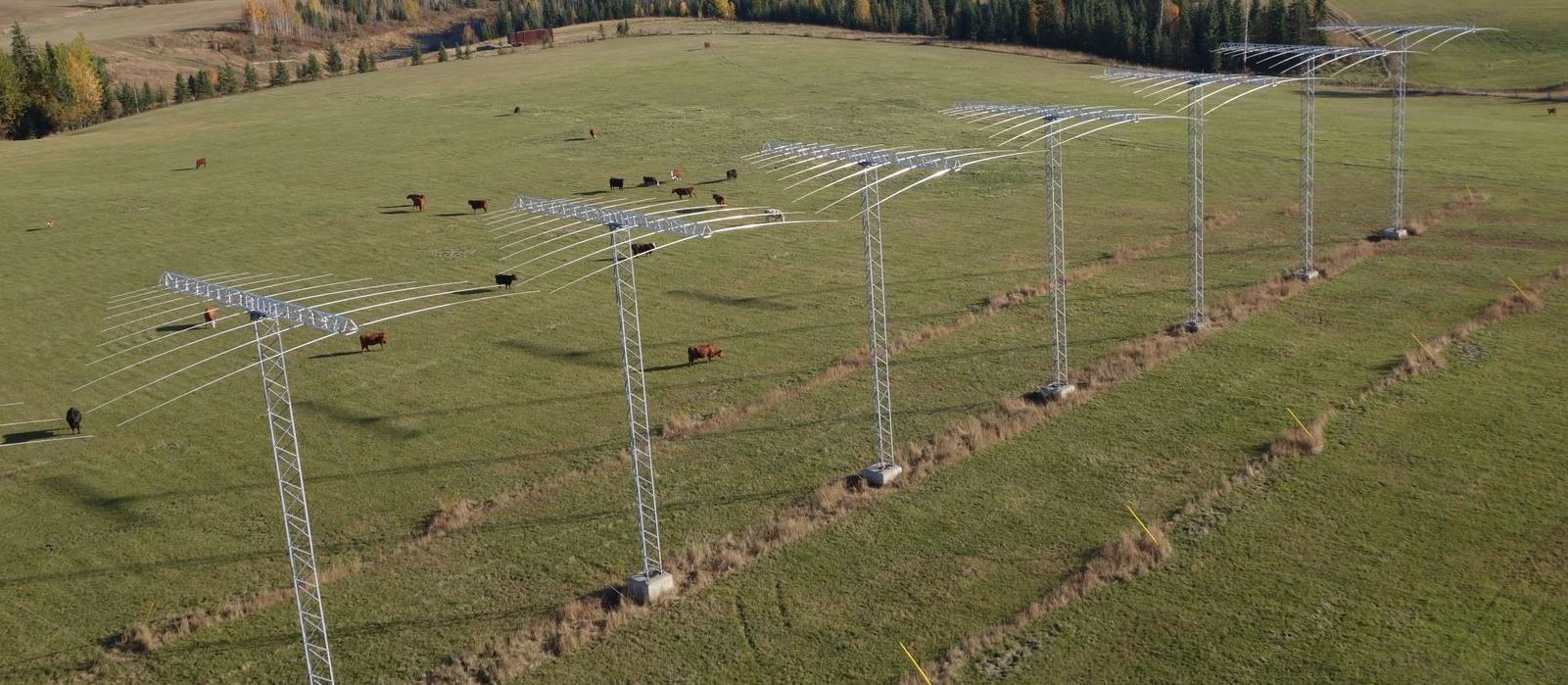
A picture of a row of our radio transmitters at Prince George, British Columbia.
If you've ever played with a car radio, you'll have seen two acronyms. AM and FM. AM stand for amplitude modulated, so the information is carried in the amplitude or size of the wave. FM is frequency modulated, where the information is carried in the frequency changes along the wave. FM is more commonly used now as it is less sensitive to interference!
The way that a moving electron produces a wave is based on how magnetic fields and electric fields interact with each other and charged particles. An electromagnetic wave is made up of oscillating electric and magnetic fields. When the electrons move in the wire, they are creating these fields which move outwards as the EM wave. For more information on EM fields and charges check out our more in-depth plasma physics tutorial series. For a brilliant overview on radio wave generation, check out this video.
Refraction, Reflection and Attenuation
Now we have our electromagnetic wave, and it is moving away from our transmitter. There are a number of things that can affect the direction, and other parts of the wave we discussed earlier. When the wave travels from one medium to another, like light travelling through air then water, the direction of the wave can change.
Firstly, the wave can be reflected when it meets the surface of the new medium. When a wave is reflected, it is reflected at the same angle that it was incident on the materials surface. Every material has a property called its refractive index which is a ratio of how well light can travel through it compared to when it travels in empty space, with nothing to slow it down. Air has a refractive index very close to that of a vacuum (1), but light travels slower in water so it's index is 1.33. Diamond has a refractive index of 2.4, and as we will discuss later, this is what makes light bounce around inside and make it sparkle.
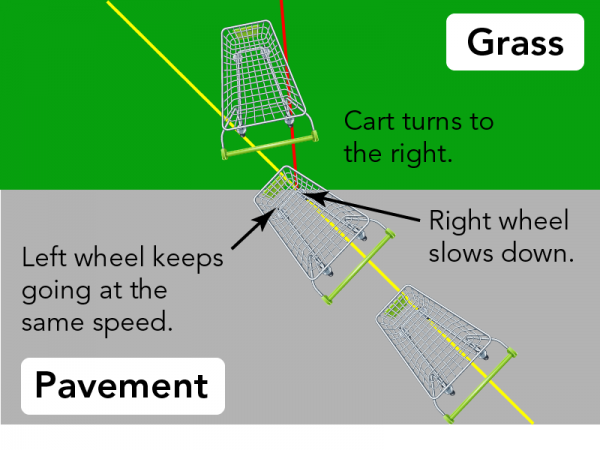
Shopping cart example of refraction. Credit: 2020 Let’s Talk Science
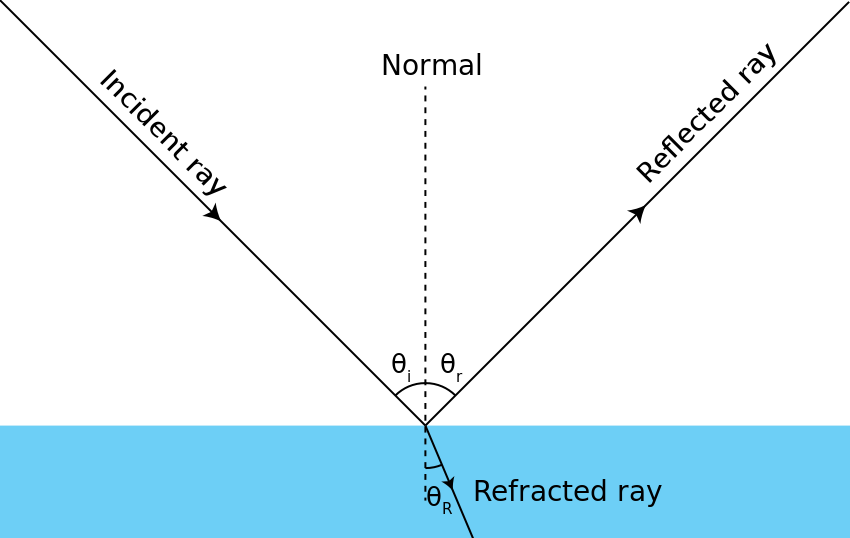
Diagram of angles of incidence, reflection, and refraction.
Refraction occurs when the light manages to get through the surface of the material without reflecting. But now that the wave has moved from a different medium with a different refractive index, the wave begins to turn. An analogy to this is when we have a boundary between a concrete or tarmac shopping center parking lot and a patch of grass. If we take the shopping cart and push it on the tarmac, it goes straight until you stop it. If we push it towards the grass, as soon as the wheel touches the grass, that wheel will slow down due to the thick grass.
The other three wheels haven't reached the grass yet, and so do not slow down. So once the wheel touches the grass, the shopping cart will start to change direction, towards the wheel which has slowed down, until the second wheel reaches the grass and the cart travels onwards straight on it's new path. This is also the reason that a pencil in a glass of water appears to bend or be disconnected.
When a material has a very high refractive index, the light that enters the material cannot escape. The change from a high to low refractive index on attempted exit is too high, and the only thing the light can do is reflect back into the material. This is called total internal reflection, and is a contributing factor to a diamond's sparkle.
The final property of a medium we will cover is it's ability to attenuate a wave. Attenuation is when the wave loses it's amplitude or intensity as it travels through a material. One example of this is as you go deeper into the ocean, the darker it gets. This is because the water is absorbing the visible light, the more water it has to travel through, the more likely it is to be absorbed. Both attenuation and refraction are affected by a wave's frequency and wavelength, red wavelengths are attenuated in water more strongly than blue, hence deep water appears with a blue hue. However, blue light is refracted more than red light, which can be seen in the famous prism experiment (diagram to right), as well as in rainbows.
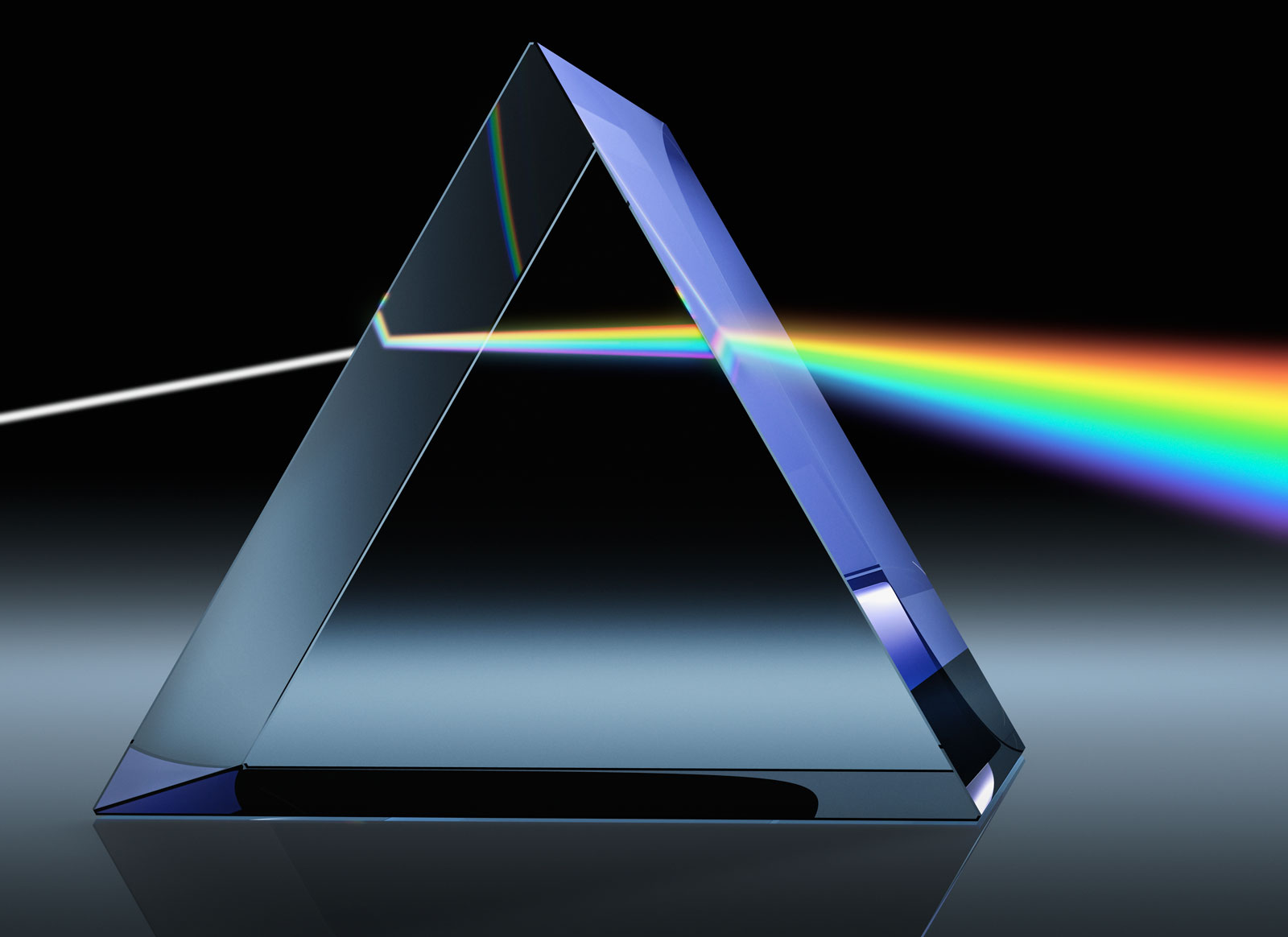
White light entering a prism is bent, or refracted. This separates the light into its constituent wavelengths. Credit: Matthias Kulka—The Image Bank/Getty Images
All three, refraction, reflection and attenuation can, and often do, happen all at the same time as a wave is travelling between different materials.
Coherence and Superposition
The phase of a wave can be though of as 'how far along the wave is at a certain time or place'. For example, if we take an ocean wave bobbing up and down, at the start of the time interval the wave is peaking, 5 seconds later is in a trough. If we imagine another wave identical to the first, but it peaks 2 seconds after the first one, we would say the phase difference between the two waves was 2 seconds. Coherence, is when two waves have the same frequency and waveform (shape of the wave), with a constant phase difference.
A integral property of all waves, even ocean waves, is that they can superpose on top of each other. So if two waves in the ocean become in phase then the waves add on top of each other and create an extra large wave. The same logic applies to antiphase waves which cancel each other out and create a flat or very small wave. The phase of a wave is measured in degrees (or radians) which describes how far around their cycle of bobbing up and down they are. These phenomena are called constructive and destructive interference

Constructive and destructive interference. Credit: Encyclopedia Britannica
Reference and Reading
- NASA Science: EM Spectrum
- NASA: Imagine the Universe
- HyperPhysics: AM and FM
- Lets talk science: refraction and reflection