
The Aurora Borealis
The Aurora
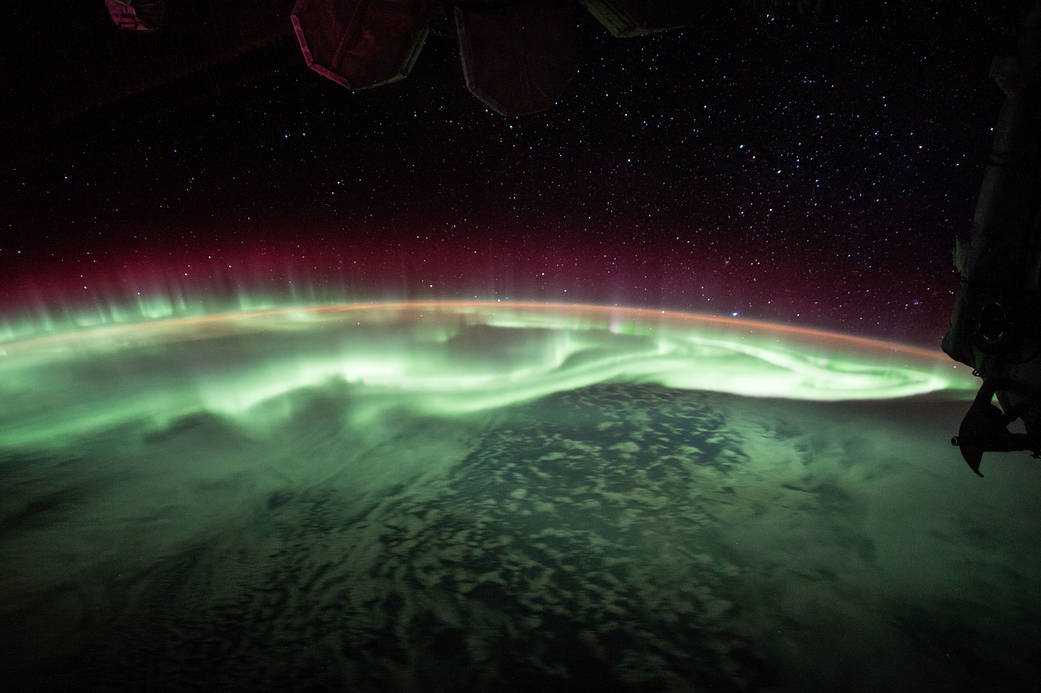
Expedition 52 Flight Engineer Jack Fischer of NASA shared photos and time-lapse video of a glowing green aurora seen from his vantage point 250 miles up, aboard the International Space Station. This aurora photo was taken on June 26, 2017. Credit: NASA
The Aurora is a beautiful show of light in the polar regions of Earth. The aurora is commonly found in an oval that surrounds the pole at around 60-70 degrees latitude. They are the results of disturbances, discussed in the previous tutorial, in the magnetosphere of Earth. The Dungey cycle causes reconnection to happen in the dayside and the tail of the magnetosphere. When this happens large amounts of energy cause the magnetic field to spring back into a straighter line, and particles from the solar wind, such as electrons and protons, are accelerated down the field lines towards Earth. As the magnetic field lines converge at the poles, we see that this happens in a circle around the poles that we call the auroral oval.
Interaction with the Atmosphere
The electrons that stream down the field lines to the Earth eventually collide with atoms and molecules in the atmosphere. As the electrons are very excited and have a large amount of energy, they hit the atom or molecule and transfer some of that energy to the atom or molecule, causing it to now be excited. This means that the atom or molecule has more energy and electrons in orbitals around the atoms are not in their lowest energy state anymore. The atom needs to relax back to its lowest energy level, and to do that the electrons must move back down to their lowest energy orbits. The extra energy is emitted as a photon of light at a specific wavelength, depending on the atom emitting it.
Green aurora is the most common and most associated colour of the aurora. This green colour comes from atomic oxygen which emits at 557.7 nanometers wavelength when excited.
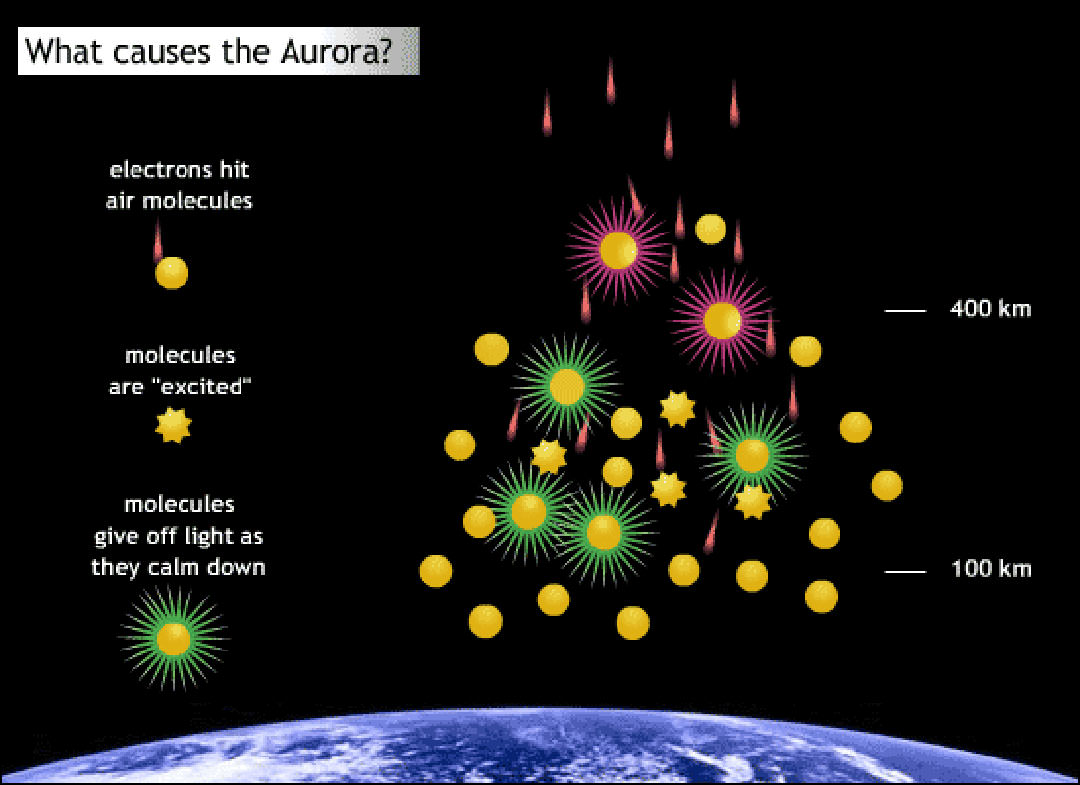
Diagram of the process by which we get photons of light that make up the aurora. Credit: NASA
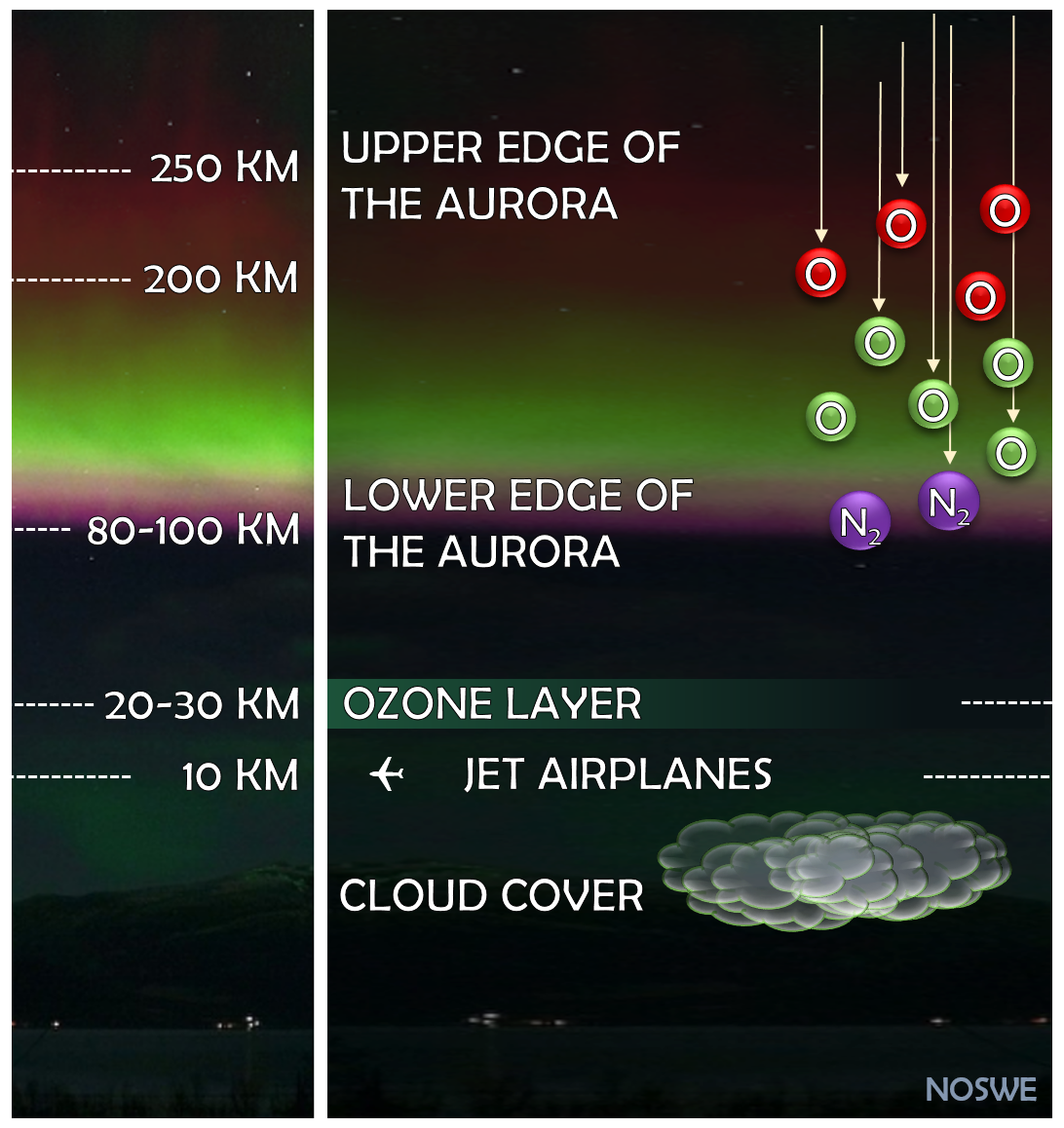
Credit: NOSWE: Norwegian Centre for Space Weather
Atomic oxygen is also responsible for red aurora, where the atom emits a photo at 630 nanometers wavelength to relax. Red aurora is common but rarer than the classic green colour. This is due to the fact that our eyes more easily see green hues, along with a long relaxation time (~100 seconds), meaning that red aurora can be quenched by other molecules and atoms colliding with the excited atom before it gets to emit. Hence we are more likely to see red aurora at higher latitudes due to the lower density.
The other visible colour of aurora, visible only during times of very high activity, is blue/purple. Blue is emitted from molecular and ionized nitrogen, at a wavelength of 428 nanometers. Blue or purple is typically found on the lowest edges of the aurora, where the highest density of nitrogen is found. Yellow and pink colours are often seen during times of high solar activity, these are generally due to a mixture of the above wavelengths acting together. On Earth we can also get infrared and ultraviolet aurora, but these area rarer and can only be seen with special equipment.
Citizen scientists discovered a new type of atmospheric emission, and named it STEVE (Strong Thermal Emission Velocity Enhancement) in 2016. STEVE is a ribbon of hot plasma at 450 km above the surface of Earth, heating the atmosphere and producing a light show.
Predicting and Seeing Aurora
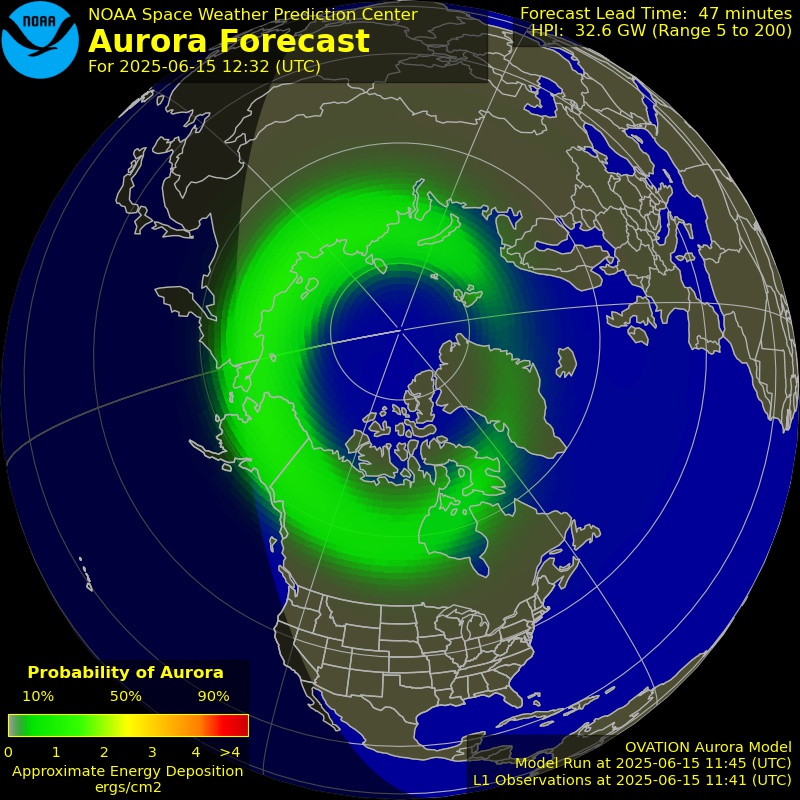
Latest aurora forecast from NOAA
Aurora is notoriously difficult to predict, however there are services such as: the NOAA aurora forecast that attempts to predict the occurrence of aurora at 30 minutes intervals using their specialized model; and the University of Alberta's aurorawatch which monitors geomagnetic conditions in the Edmonton and wider Alberta area. The best way to find out if aurora might be active in your area is to look at the solar wind conditions. There is a satellite that is positioned just in front of Earth called ACE. ACE transmits data to Earth and you can see what the solar wind conditions will be like.
Below is the real time ACE data for the last 24 hours. The top panel shows the magnetic field in red. To produce aurora, we typically need a few hours with a negative magnetic field, indicating a southward magnetic field. The other panels show the density, speed and temperature. They are less important to aurora, with the exception of density which must be relatively high. If you live below 70 degrees in latitude, you must find a dark sky area and look to the north to see aurora on the horizon unless there is a large amount of activity. Make sure you are not south of a big city to avoid light pollution. Always be aware of your surroundings and stay safe at night.
The NOAA Aurora forecast is now also available on our real-time fan plots as an add-on option.
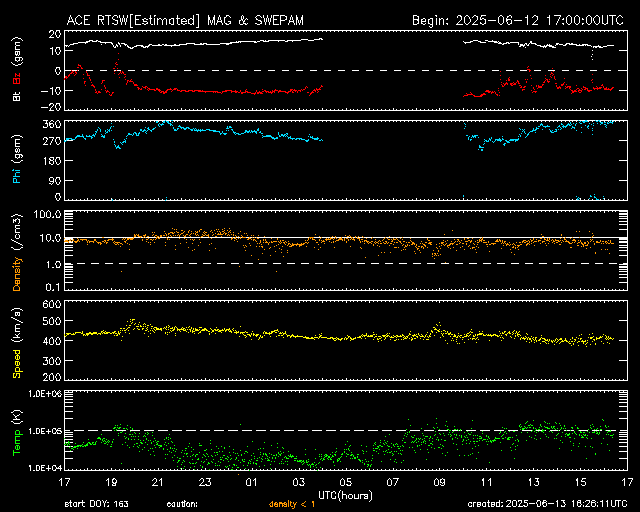
Latest ACE data from NOAA
Reading and References:
- ACE: Real time solar wind
- University of Alberta: aurorawatch
- NOAA: Aurora Forecast
- NASA Space Place for Kids: What is Aurora?
- NASA: Aurora
- CSA: Northern Lights