
Earth's Plasma Environment
Frozen In Flux
The most important part of MHD (see An Intro to Plasma tutorial) to consider in Earth's plasma environment is the Frozen-In Theorem, also known as Alfvén's Theorem. Alfvén stated that "in a fluid with infinite electric conductivity, the magnetic field is frozen into the fluid and has to move along with it". What this means is that, because a plasma is made of electrons and ions, it has very very low resistive properties (that inhibit electric current from flowing), and so has a near infinite ability to conduct electricity. When this occurs, the magnetic field, and the plasma, are 'stuck' to each other.
If the plasma moves, so do the magnetic field lines and vice versa. The field lines are similar to elastic bands that want to be as straight as possible. So, the field lines will exert a force (called the tension force) on the plasma to move it. Or, the magnetic field is frozen into the plasma. We can measure the ratio between the magnetic tension force and the plasma pressure to discover which of the two is in control, this ratio is called the plasma beta and is used frequently to describe the types of plasma in our solar system.
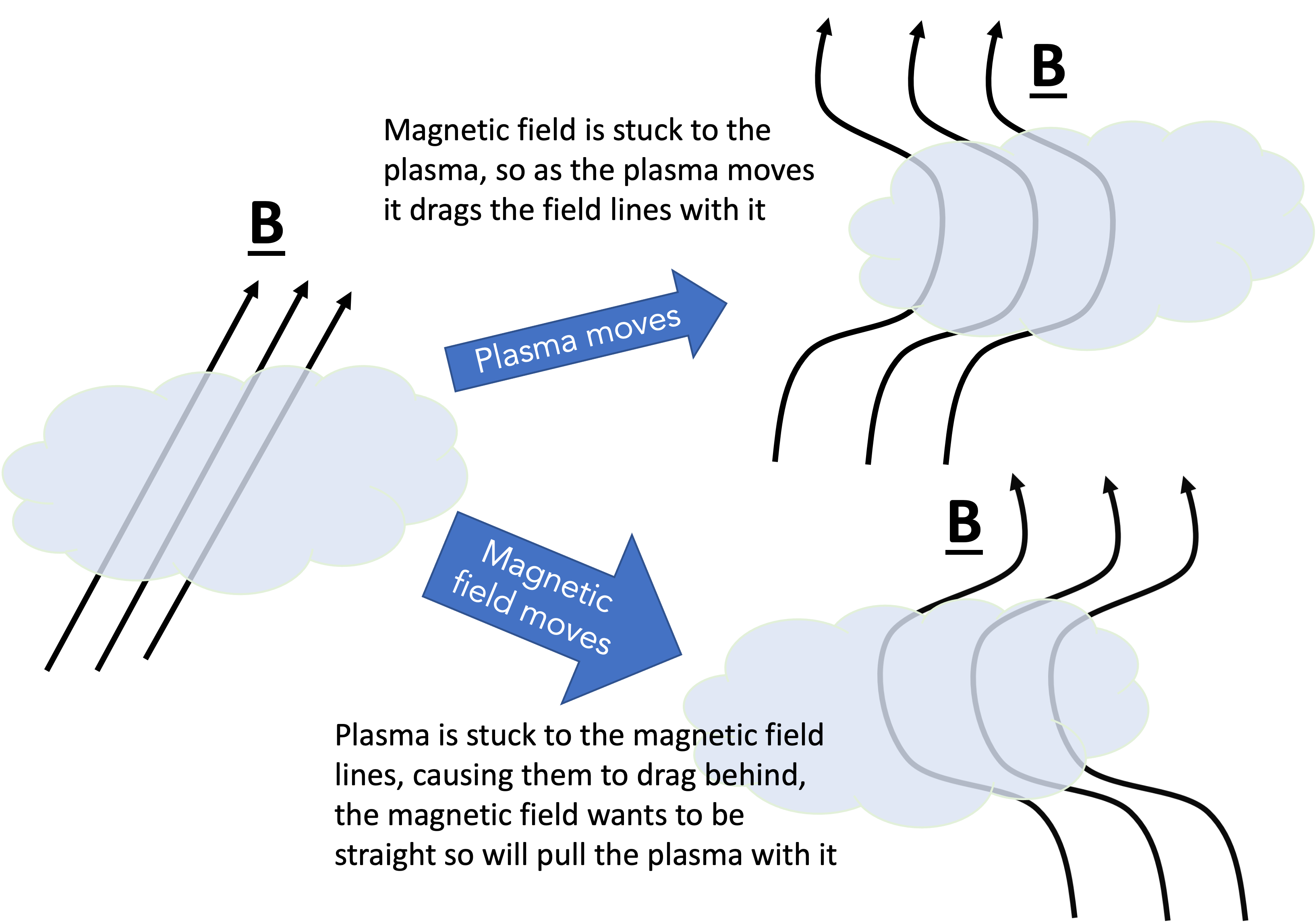
Diagram of plasma and magnetic field interacting due to the frozen in theorem.
Drifts in Earth's Magnetosphere
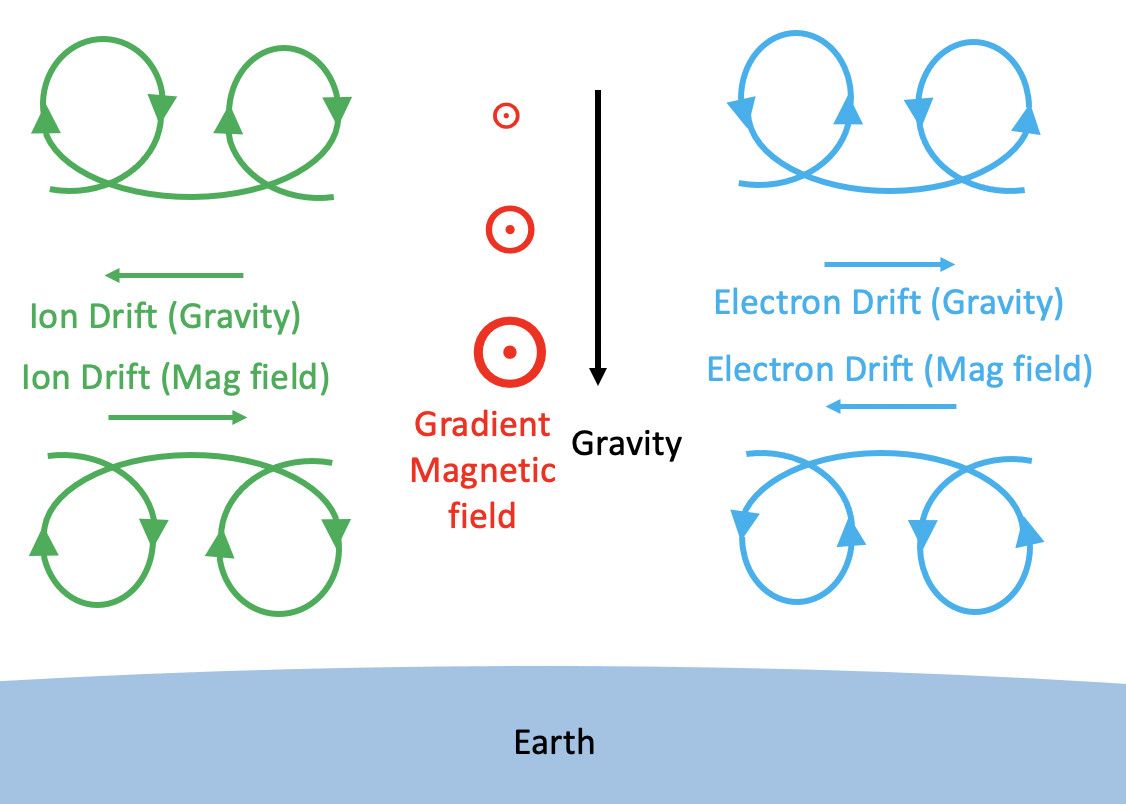
Diagram of two different drifts possible in the magnetosphere at Earth's equator.
In the An Intro to Plasma tutorial,
we discussed the many types of drifts and how they are set up. In this section
we will discuss the applications of those drifts to Earth's environment.
Earth's magnetic field is somewhat like a bar magnet.
Many ions and electrons are found gyrating around the magnetic field of the Earth.
When adding in other physics to the situation, we can see how many types of drifts occur.
At Earths equator, all the field lines are parallel to the surface and pointing northward. We also see that Earth exerts a gravitational force on any particles that may be gyrating on those field lines. Hence we have an external force downward towards the Earth. It then follows that a separation of charges could occur as electrons drift in one direction and ions in the other.
But wait! We also have a magnetic field that decreases in strength with distance from the Earth's surface. Hence, we see that a current is set up in the magnetic field around the equator, but there are two opposing mechanisms at work. Where one overpowers the other, a current forms and we call this current the ring current.
Field lines converge at the poles. This means that the magnetic field is stronger at the poles than at the equator. Velocity parellel to the magnetic field causes particles to drift along the field lines, whereas velocity perpendicular (gyromotion) causes particles to move in a circle around the field. Together, they produce a helix as the particle moves. The convergence of the magnetic field lines at the poles leads to the particles bouncing back and returning the way they came. This leads to the particles bouncing from pole to pole, along the field lines repeatedly.

In the Earth dipolar field, the motion of a charged particle has three components: Gyration around the magnetic field line, bounce between the mirror points, and drift around the Earth. The direction of the drift motion depends on the charge sign, therefore a ring current is produced. Figure adapted from Iver Cairns (http://www.physics.usyd.edu.au)
This bouncing is due to a property called the magnetic moment. The magnetic moment is an invariant, this means that on the time and space scales we observe in this situation, we can consider it to be a constant. The magnetic moment is dependent on the magnetic field and the energy of the particle (related to the angle between the parallel and perpendicular velocities). As the magnetic field strength increases, the angle between the velocities must grow if the magnetic moment is to be kept the same. However, the angle cannot grow to more than 90 degrees. At this point the parallel velocity reaches zero and then reverses, making the particle bounce. This process is called magnetic mirroring. This trapped population of particles in the magnetosphere is what makes up the radiation belts at Earth.
References and Reading:
- Encyclopedia Britannica: Magnetic Mirror
- Alfvén's Theorem and the Frozen Flux Approximation by Paul H. Roberts
- NASA: Radiation Belts
- Introduction to Space Physics by Kivelson and Russell