
The Sun
Introduction
Make sure to never look at the Sun without protection. When scientists 'look' at the Sun, they always look through special telescopes which block all of the harmful bright light. During a solar eclipse, we can use special glasses which allow us to look safely at the Sun.
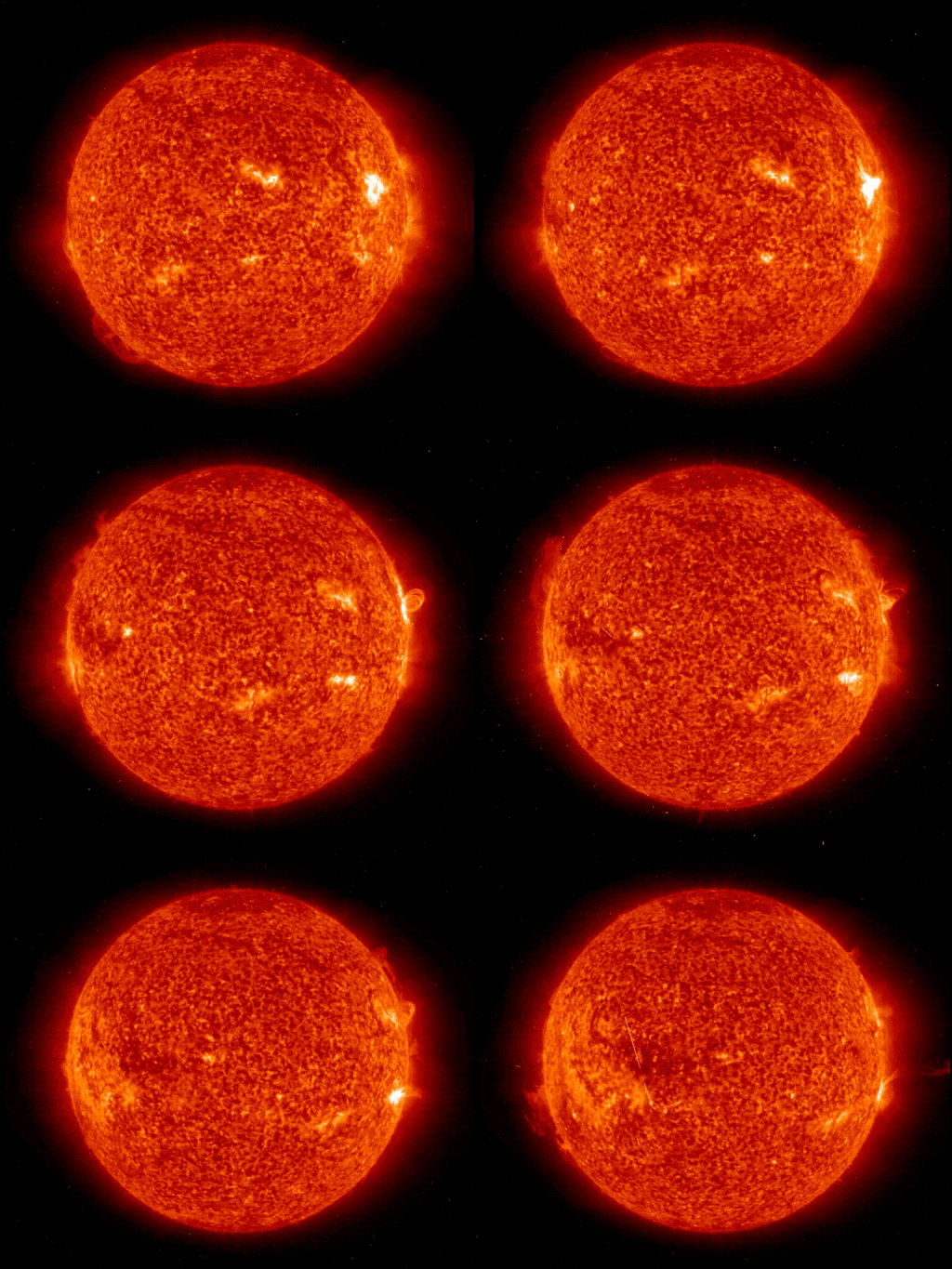
Images of the Sun rotating. Credit: NASA's Goddard Space Flight Center
The Sun, our nearest star, is a G-type star. This means that the star has an average temperature of 5300-6000 degrees Kelvin (~5500-6300 degrees Celcius). At this temperature, the colour of the light emitted by our Sun is yellow-white. The Sun is the most important source of energy for life as we know it on Earth.
The Sun is made up of ~73% Hydrogen, and ~25% Helium. The remainder is made up of heavier elements, such as Oxygen and Carbon. The Sun was formed around 4.6 billion years ago, where a large cloud of mainly Hydrogen and Helium collapsed under its own gravity, or all the atoms and molecules grew closer together and accumulated into clumps and a disk. The most central clump grew into our Sun, and the remaining matter formed a disk which eventually created the rest of the solar system. This big central clump of matter became very hot and very dense as more and more material accumulated. The heat and density ignited the core where nuclear fusion began to convert mass into energy and heavier atoms.
The Interior
The inside of the Sun is split into 3 main sections: the core, the radiative zone and the convective zone. Right at the center we have the core. The core is the hottest region of the interior of the Sun. This is where nuclear fusion reactions occur.
Nuclear fusion is when two atomic nuclei combine to form a heavier atomic nuclei. This process releases a large amount of energy, and is the energy process that makes the Sun hot. Inside the Sun, nuclear fusion combines two Hydrogen atoms to make heavier Hydrogen, and further fusion events can keep combining extra protons and neutrons to make heavier and heavier elements.
Outside the core, we have the Radiative zone, so called due to the way energy is transported away from the core. Inside this layer, energy is carried by photons, or as radiation. The temperature of this region drops from 15 million degrees Kelvin near the core, to 1.5 million degrees Kelvin near the edge of the zone.
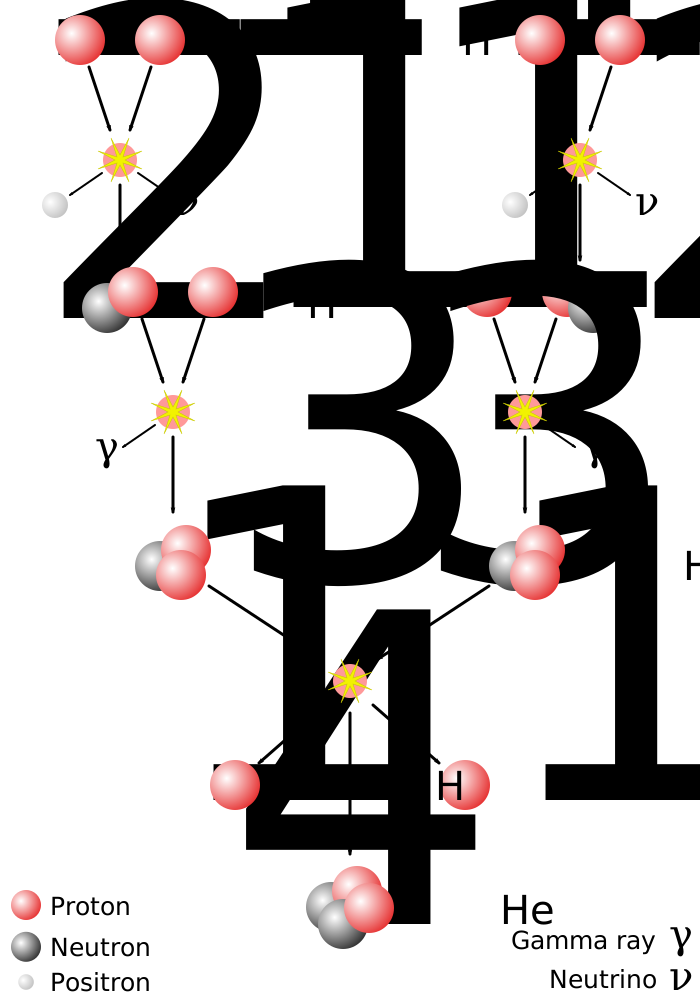
Summary diagram of how Hydrogen atoms lose energy as a photon and an electron to combine and make heavier Hydrogen and Helium.
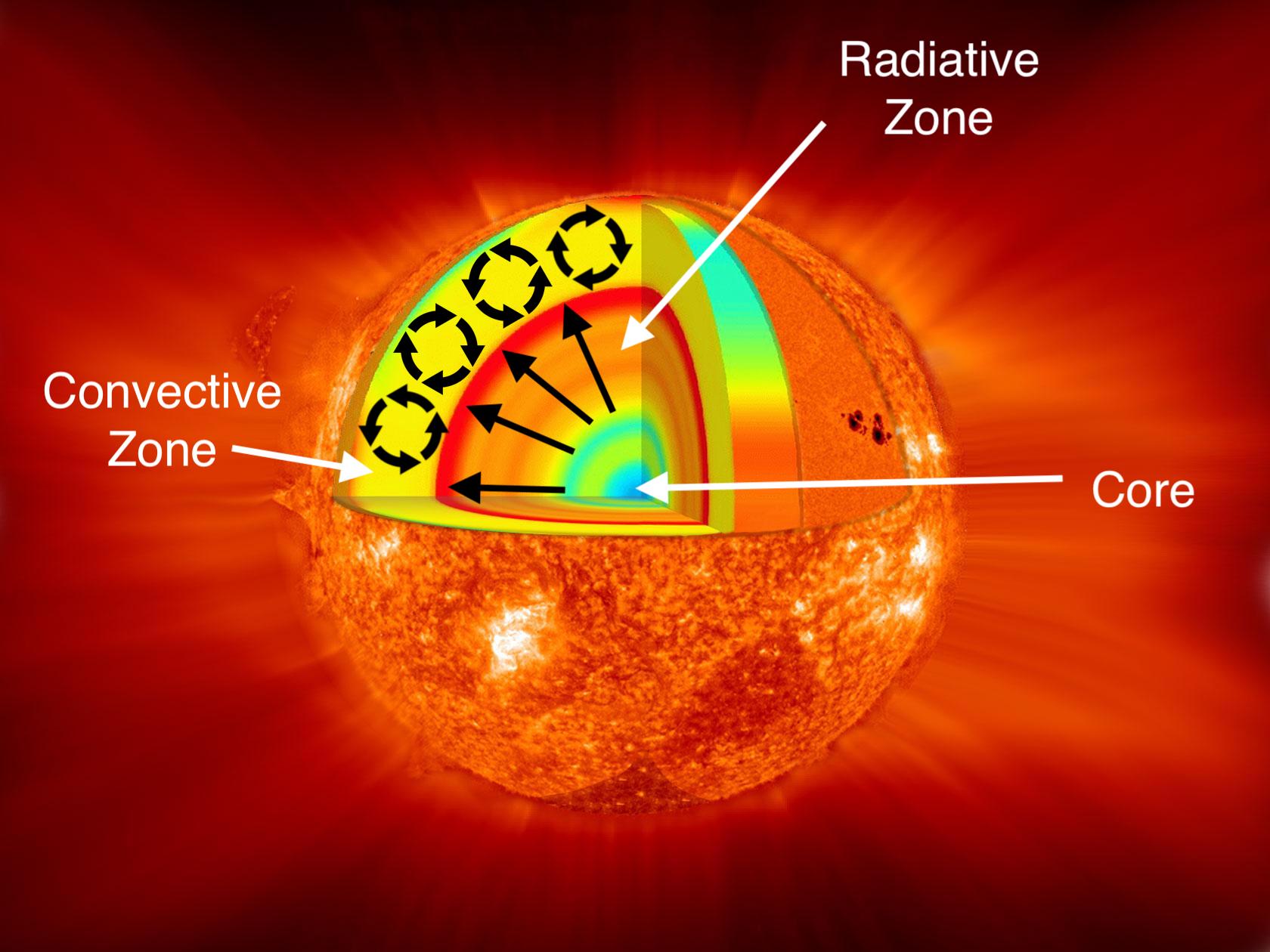
Image showing the different interior layers of the Sun. Credit: modified from NASA's Goddard Space Flight Center
The last interior layer is called the convective zone, this is due to the fact that energy is now transported by convection. This means that plasma inside the star is moving en-masse. Hot plasma near the radiative zone rises and cools towards the surface, and the cooler surface plasma descends to form a cycle of convection of plasma in this region. This region cools plasma from 1.5 million Kelvin to around 5500 Kelvin.
The radiative zone is so dense that it takes an average of 170,000 years for radiation to travel through the entire zone. This is because photons are quickly absorbed by nearby atoms which then re-radiate them, with this process repeating until the photon finally makes its way through the zone. In comparison, the energy only takes just over a week to travel through the convective zone to the surface.
Surface and Atmospheric Layers
The surface of the Sun that we can see is called the Photosphere, as it emits light in the visible area of the spectrum. We can see sunspots on the photosphere, but otherwise the photosphere is relatively smooth and unchanging.
Above the surface layer, we find the chromosphere. The chromosphere is a red color, but is generally drowned out by the brightness of the photosphere beneath. During a solar eclipse, we can sometimes see the red features of the chromosphere. Viewing the chromosphere also allows scientists to see many other features in the lower atmosphere.
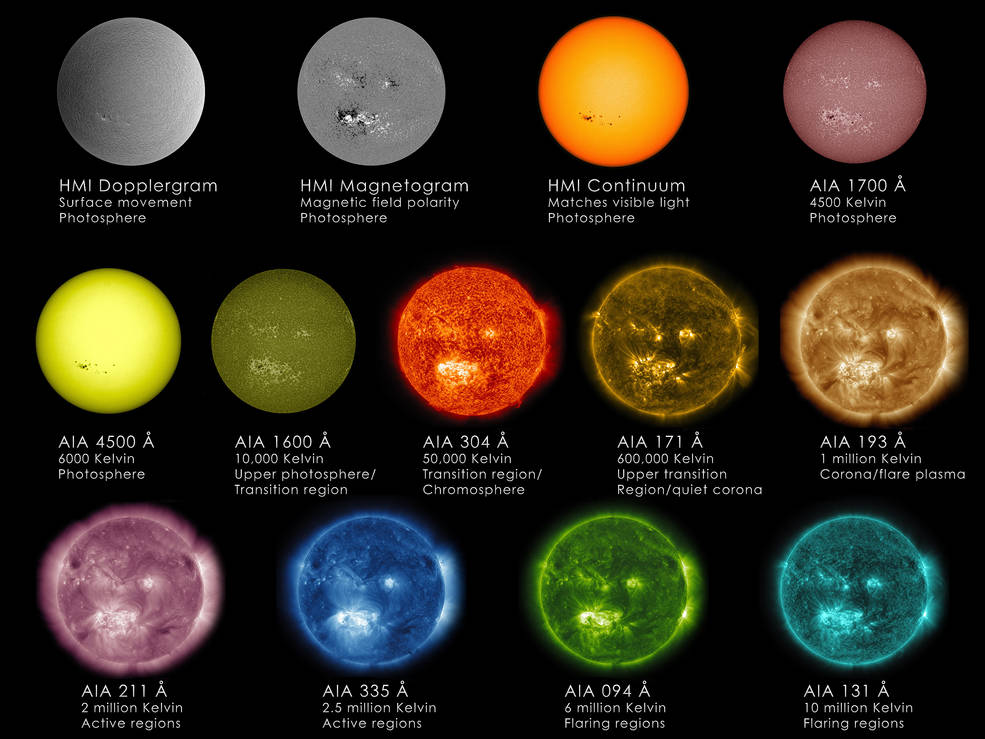
The Solar Dynamics Observatory views the sun in 13 different ways, using two different on-board instruments. Credit: modified from NASA/SDO/Goddard Space Flight Center
The Sun's upper atmosphere is called the Corona. It extends thousands of kilometers above the photosphere. The Corona is extremely hot - hotter than the center of the Sun - and is a very sparse plasma. This is the layer of the Sun that you can see during a solar eclipse. Even though we can't see the corona normally, the layer is still very bright, it is just far dimmer than the photosphere.
The very high temperatures of the solar corona are still an open question in solar physics. Scientists still don't know where all that heat comes from!
The Sun's Magnetic Field
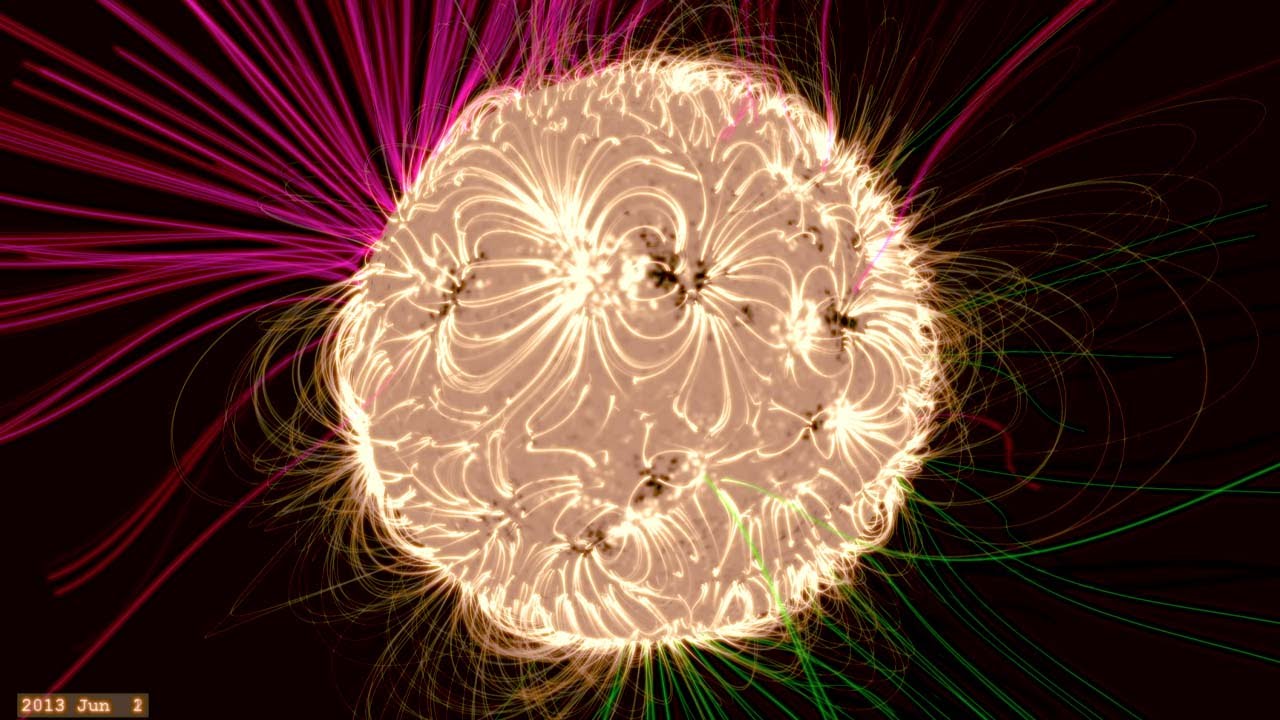
Computer model of what the magnetic field of the Sun looks like. The loops can be seen going in and out of the surface. Credit: NASA's Goddard Space Flight Center/Duberstein
The Sun has a very, very large magnetic field. This field looks like a very big version of a magnet. The Sun, however, exhibits differential rotation, meaning that the equator of the Sun spins faster than the poles. This rotation means that the magnetic field is spun around at different rates and gets all messed up at the surface of the sun and starts to poke through in different areas, in loops. These loops can carry plasma from the surface into the Corona. We call these prominences.
Prominences usually contain cooler material than the plasma on the surface. As such, if the prominence is not on the edge of the Sun, it appears like a long dark river on the bright surface background when viewing the chromosphere.
Sunspots
When the magnetic field pokes through the surface of the sun in bunches, it stops the plasma in the convection zone from effectively moving new hot plasma into that region. This causes the area to appear darker as it contains cooler material. Sunspots are made up of two areas, the umbra, which is the central darkest region of the sunspot, where the magnetic field is at right angles to the surface. The penumbra is around the umbra where the magnetic field isn't quite perpendicular, and so some new hot plasma can get there and so the area is not as dark or cool as the umbra.
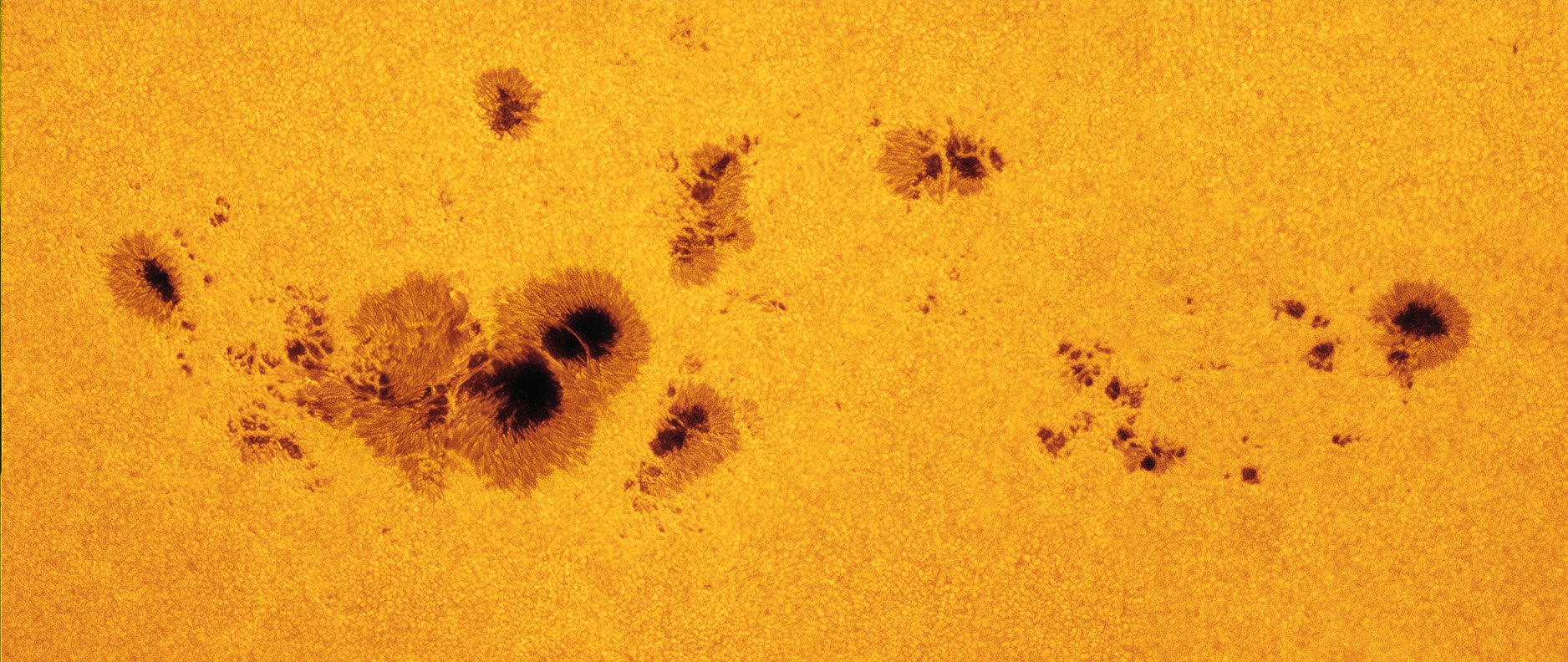
View of a group of sunspots on the Sun's surface. Credit: NASA's Goddard Space Flight Center/Duberstein
The Solar Cycle
The number of sunspots on the Sun has knock-on effects on Earth. In the 1600's very few sunspots were seen for over 50 years. This coincided with a 'mini ice-age' in Medieval Europe. Winters were particularly cold during this time, even the Thames River in London froze over. Scientists call this time the Maunder Minimum after astronomers Annie and Edward Maunder.
The solar cycle is a cycle of magnetic activity on the Sun. It is measured by the number of sunspots scientists count on the surface. The cycle itself is around 11 years in length, starting from a solar minimum where very little activity is seen on the surface. The number of sunspots then grows to a solar maximum where we see an increase in all solar activity, from sunspots to solar flares to mass ejections of material outwards. The activity then decreases back to the minimum and then the polarity of the magnetic field changes, so if the northern pole of the Sun was the north pole of a magnet (the magnetic field line point outwards from the surface), it then becomes the south pole of a magnet (magnetic field lines point inwards) for the next 11 year cycle.
Solar Flares and Coronal Mass Ejections
Earlier, we mentioned prominences. Prominences often fall back down to the Sun's surface. However, sometimes the plasma and magnetic field have enough energy to escape from the gravitational pull of the Sun. The magnetic field 'breaks' and all the plasma is lost into space. When this happens, scientists call this event a Coronal Mass Ejection.
These events are slightly different from solar flares, but the two can occur simultaneously. A solar flare is a quick release of photons from the surface of the Sun around sunspots and prominences, where magnetic field lines tangle and cross. When the magnetic field reorganizes, it releases a large amount of energy in the form of photons. The photons released can be from anywhere in the electromagnetic spectrum.
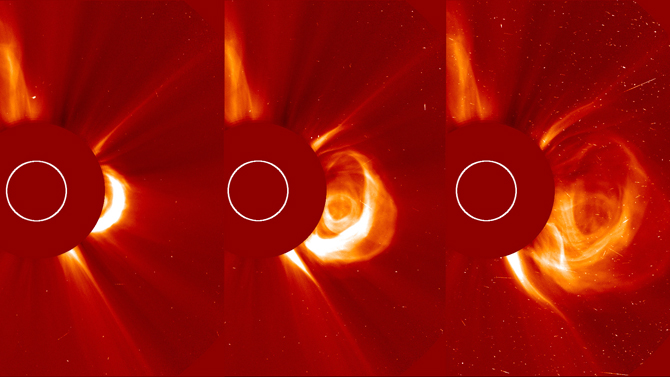
On May 16, 2012 at 9:47 PM EDT, the sun erupted with a coronal mass ejection traveling at over 900 miles per second. Credit: ESA & NASA/SOHO
References and Further Reading:
- NASA: The Sun in different Wavelengths
- NASA Space Place: Solar Cycle
- NASA SOHO: Live Sunspots
- NASA: Solar Interior
- Encyclopedia Britannica: Maunder Minimum
- NOAA: Solar Phenomena