
Solar Wind
The Solar Wind
The solar wind is a constant stream of charged particles which continually flow from the Sun's upper atmosphere, the Corona. The plasma itself consists of mainly electrons, protons and alpha particles (Helium atom nuclei). However, it does contain traces of heavier elements.
As the solar wind travels outwards, it becomes supersonic (faster than sound waves can travel in a medium) at around a few solar radii. Scientists measures distances in the solar system using references to nearby objects, like the Sun, so that the distance is more easily imagined. A solar radii is around 700,000 kilometers, which is a bit more difficult to imagine.
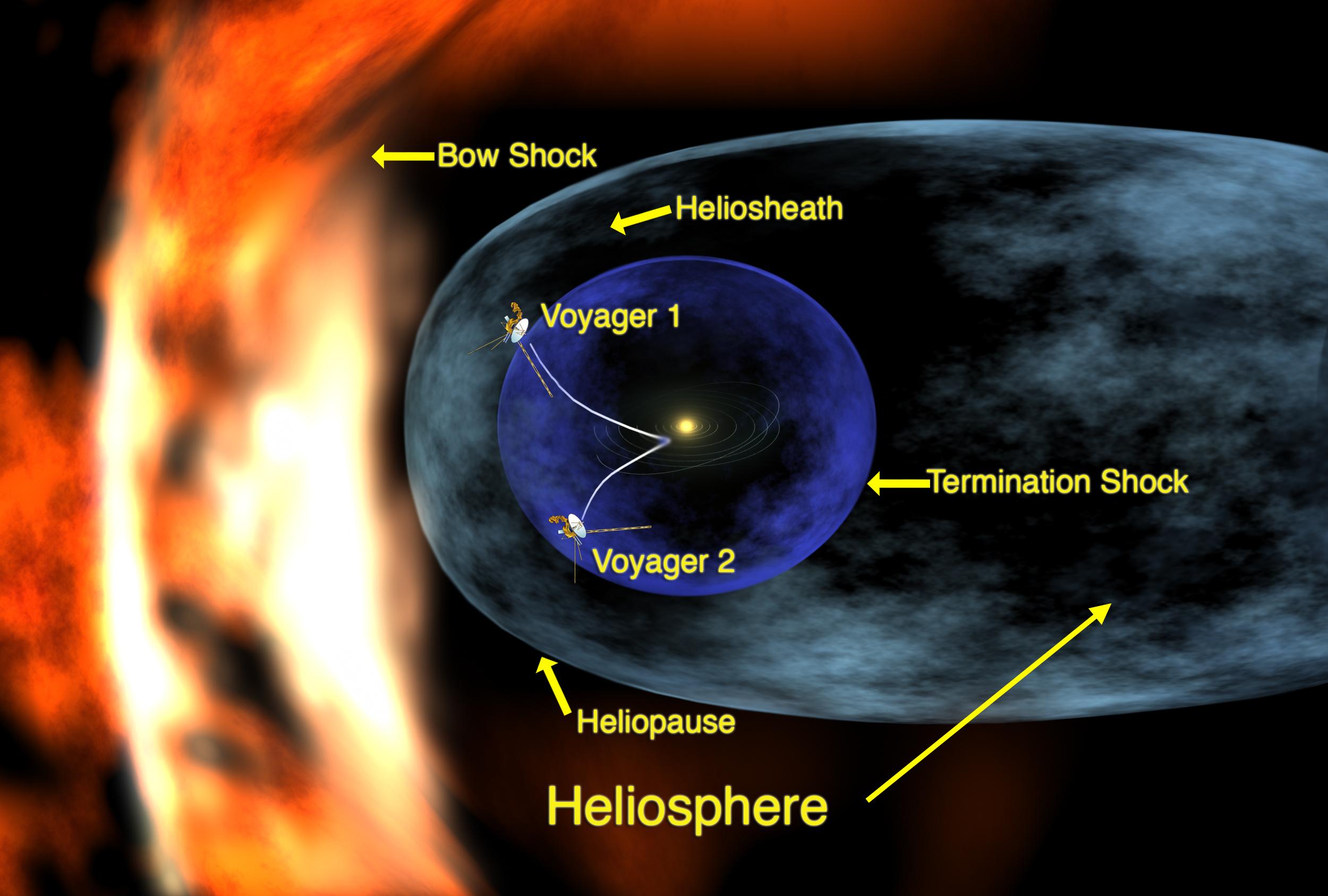
Different regions of the heliosphere- where the solar wind propagates. Credit: NASA/Goddard/Walt Feimer
The solar wind then travels all the way past the planets, past the Kuiper belt objects, and slows until it gets to the termination shock. This is where the solar wind becomes sub-sonic again. The termination shock is around 75 to 90 astronomical units (AU). An AU is another unit of measurement for distance, where 1 AU is the distance between the Earth and the Sun. So, the termination shock is around 75-90 times further from the Sun than Earth is. Two spacecraft, Voyager 1 and 2, crossed the termination shock in 2004 and 2007 respectively.
The solar wind varies in density, temperature, and speed over solar latitude (how far towards the poles the wind originated). The Ulysses spacecraft measured that solar wind is generally faster and more tenuous over the poles, and slower and denser if it originated near the equator.
By the time the solar wind reaches Earth, it is almost always supersonic, ranging from 250 - 700 km/s. If the solar wind is between 250 and 500 km/s we call that a slow solar wind, and if the speed is 500+ km/s, this is a fast solar wind. The slow solar wind is generally twice as dense as the fast solar wind near Earth's orbit.
The Interplanetary Magnetic Field
As the solar wind particles stream outwards from the sun, they also bring with it the magnetic field of the Sun. The particles are a plasma and the magnetic field is frozen-in to this plasma. This magnetic field is called the interplanetary magnetic field (IMF). The Sun, however, is rotating all the time, at between 25 and 36 days for one rotation. The rotation, coupled with the plasma dragging the magnetic field outwards, creates a spiral shape in the magnetic field, called the Parker Spiral.
This spiral is generally the 'background' field that Earth experiences. By the time the spiral arrives at Earth, the angle of this spiral (how sideways the magnetic field is) is usually around 45 degrees. Further out at Saturn, it is often almost 90 degrees. On top of this spiral, we can see extra solar activity, such as coronal mass ejections which send particles out and drag the magnetic field at a much faster speed. This causes compressed regions of particles infront and rarefied regions behind the travelling coronal mass ejection. Due to the rotation of the Sun, it is also common to see a 25 day cycle of solar wind conditions, as the same regions return from a rotation around the Sun.
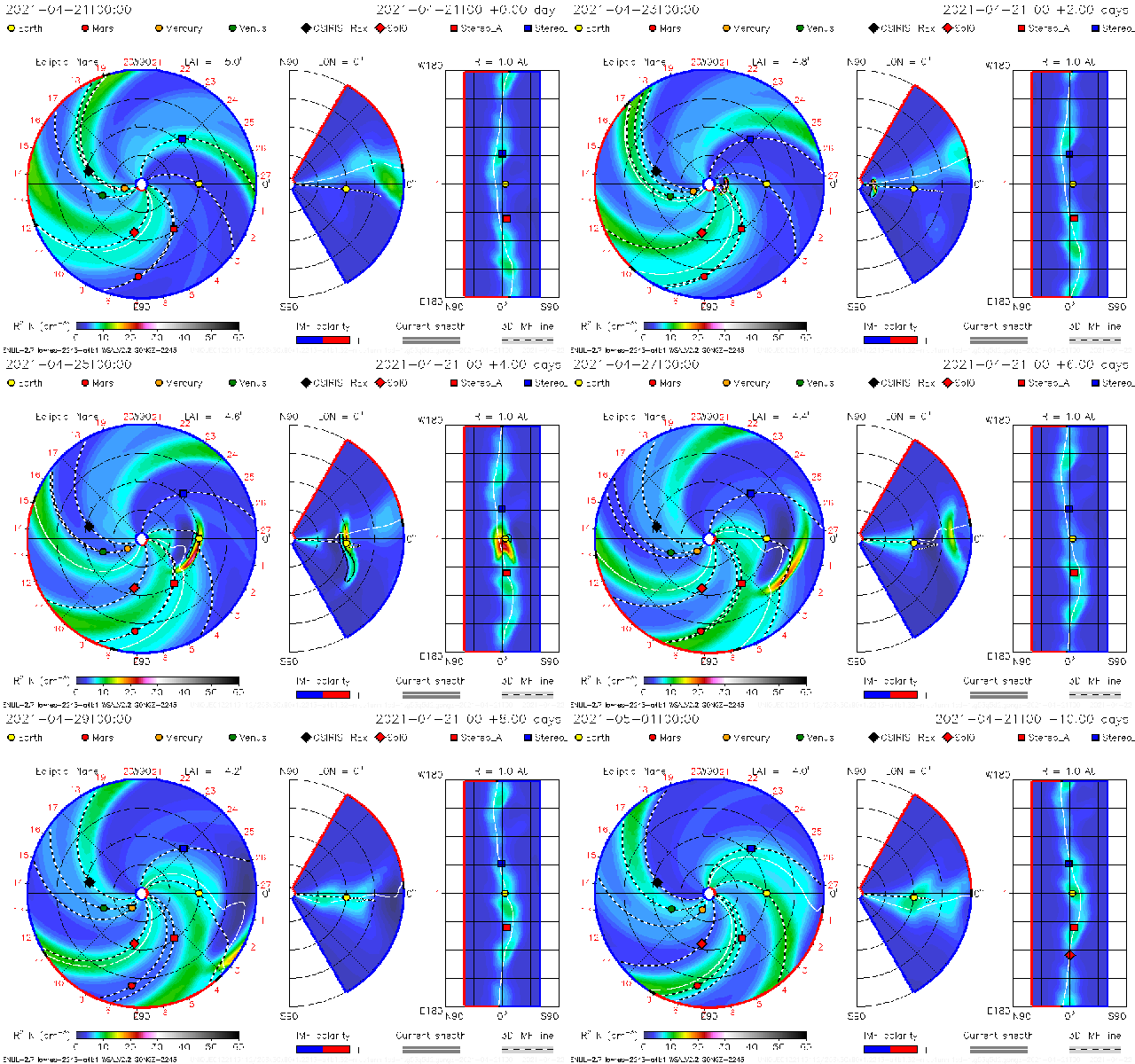
A Model showing the general Parker spiral magnetic field with superposed fast region caused by a coronal mass ejection. Credit: https://iswa.gsfc.nasa.gov/
References and Reading: