
Waves
What is a wave?
Waves are found everywhere in everyday life, from skipping stones on a pond to sound waves that allow us to talk to each other. Light is also a wave, which we have evolved to use to see the world around us.
The main job of a wave is to move energy from one place to another. This is done by causing a disturbance in a medium. A medium is the material that the wave is travelling in. For example, a wave on the ocean travels through water, and a sound wave travels through the air. However, the particles in the air or water do not move, on average, away from where they started. Hence, the wave is carrying energy, and not the medium itself from point to point.
It is important to note too, that the medium in which a wave travels does not create the wave, only allows it to travel through. A wave on the ocean is caused by wind blowing along the surface, transferring the winds energy, into the up and down energy of the waves. In the air, a sound wave is made in our voice box when we talk, and the vibrations of the voice box transfer to vibration in the air which then travel towards the person listening.

Ripples on a pond moving the energy of the stone that was dropped, away as waves. Credit : YJ.K/Shutterstock
Transverse and Longitudinal
The two examples, water waves and sound waves, are actually examples of two different types of waves. Waves on the ocean cause the water to move up and down as the wave passes: this is called a transverse wave, where the movement of the individual water molecules is at a right angle to the travelling direction of the wave.
Sound waves, however, are an example of longitudinal waves. The particles in the air vibrate backwards and forwards changing how dense, or how many particles of air there are in the same area. This movement of the individual air molecules is in the same direction that the sound is travelling.

Example of a transverse wave, where the particle is moving up and down, but the wave is travelling from left to right. Credit: University of California, Davies, CC BY-NC-SA 3.0
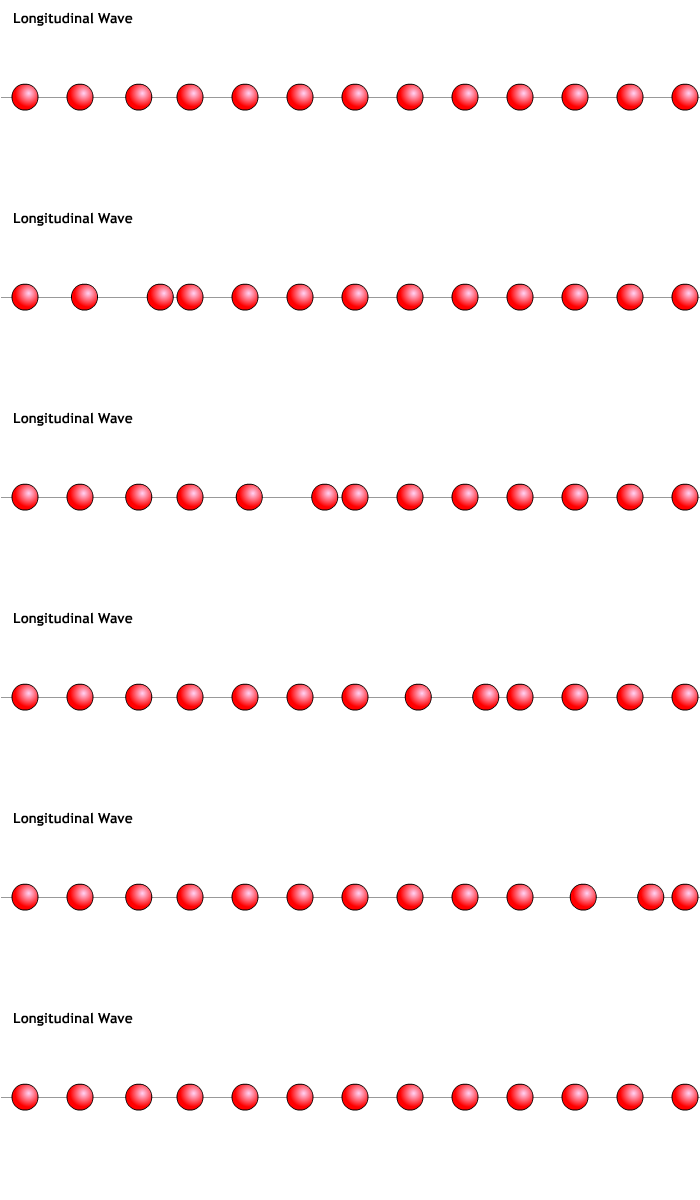
Example of a longitudinal wave where the particles are moving left to right and back again, and the wave is travelling from left to right.
References and Further Reading