
Electricity and Magnetism
Electricity
Electricity is all around us, everyday. We see electricity in nature in lightning strikes, and even inside our brains, helping us think. Modern life is heavily influenced by man-made technology that uses electricity as it's basic power source. So, what really is electricity? In short, electricity is movement of charge. Charge is a fundamental property of particles. In the tutorial Atoms, Molecules and Ions, we showed that different parts of the atoms have different charges. Electrons have a negative charge, and protons have a positive charge.
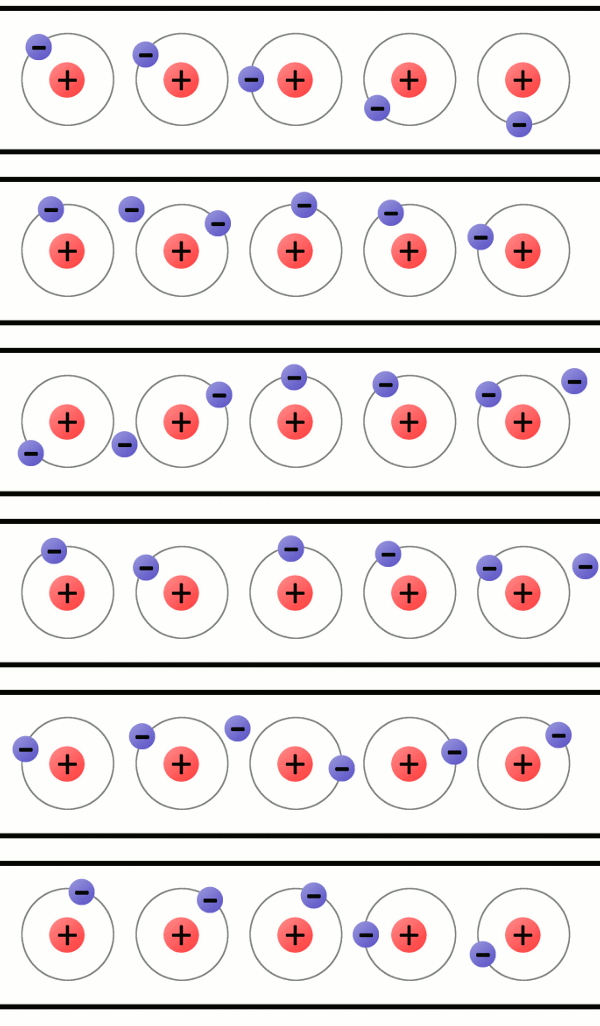
Simplified view of electrons moving in a wire. Credit: Spark Fun
But how to we get these charges to flow? The easiest way is to move the electrons themselves, which contain a negative charge. Atoms can have many numbers of electrons orbiting their nucleus, but the outermost electrons are more able to be lost to another atom. In metals, the outer electrons in the atoms are not strongly bound and so can move around inside the metal between atoms. We call these free electrons. This is also why we use copper, a type of metal for electrical wires.
One electron moving from one atom to another will not produce a lot of electricity. To power a lightbulb, for example, we would need many more electrons moving through a wire. This is where electrostatic force comes into play. Electrostatic force is the name we give to the idea that opposites attract and likes repel. So two negatively charged electrons will try to move away from each other, but a positive proton and negative electron will move towards each other. In a wire, if a negative electron moves from one atom to another, this will also cause any other free electrons to be pushed from that atom to the next, and so on and so on all along the wire. In this sense, the electrostatic force helps us move a lot of charges along a wire, to produce electricity.
Like a metal, plasma also can conduct electricity. It is made of ions and electrons meaning that there are a lot of charges, which when moved can conduct electricity. Here at SuperDARN Canada, the ability of plasma to conduct electricity is a very important concept for tracking the movement of ions in the atmosphere.
Electric Fields
Now we have moving electrons to produce electricity, but how do we get the electrons to move in the first place? An electric field is often the source of this movement. A field, is simply a way that we can describe how any point in space is affected by a force. We can't see fields, but we can feel them. A common example, that we feel every day, is the gravitational field of Earth. We can't see it, but we can feel it keeping us on Earth's surface. If we were to drop an object from height, we know that the object will fall to the ground. An electric field is very similar, where the object will be a charge. If we 'drop' a charge in an electric field, the charge will move along the field until it is stopped.
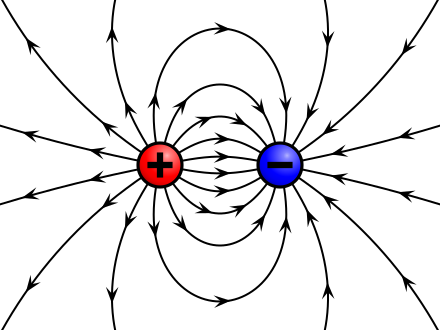
Field of a positive and a negative point charge. Credit: WikimediaCommons: Geek3
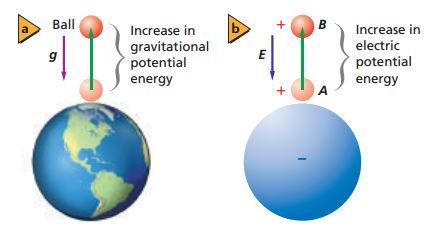
Comparing gravitational fields to electric fields. Credit: Glencoe Science Physics, Chapter 21
The biggest difference between Earth's gravitational field, and electric fields is that the gravitation field only attracts, but electric fields can both attract and repel charges. Using the same gravity analogy, we can increase the potential energy of an object if we raise it up high. That object has the potential to move a long way to reach the ground. In an electric field, the electric potential energy describes how much energy that is stored in the charge, which can be converted to the movement of the charge as it moves along the field. Increasing the potential energy of a charge, will cause the charge to move and hence, make electricity.
Magnetism and Magnetic Fields
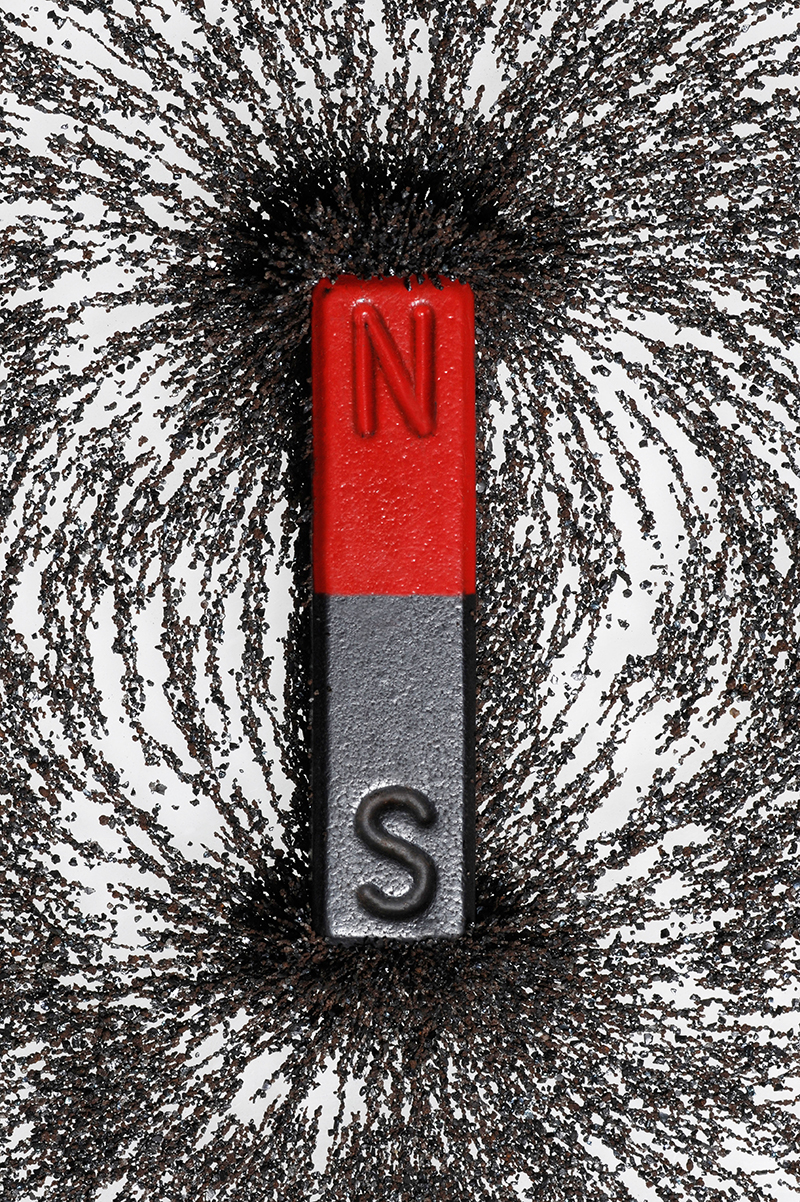
A magnetic dipole, consisting of a north magnetic pole (red "N") and a south magnetic pole (black "S"). Iron filings affected by the magnet reveal magnetic field lines, which converge at the poles. Credit: Alchemy/Alamy
Magnetism is a very unique property of some materials. Inside these materials, there are electrons which spin. The electrons themselves do not physically spin, but this is a good visualisation of a much more complex property. Electrons can spin in different directions, and in most materials the spins of electrons are random and in all different directions equally, which will cancel each other out. In some materials however, electrons all spin or can be made to spin in the same or similar directions, making a magnet with two poles. North and South.
Earth is a big magnet, the center of the Earth is made from iron and moves around making it a dynamo which forms a magnetic field. However, the orientation of the magnetic field of the Earth is the opposite of the geographic poles. The North geographic pole is actually a South magnetic pole!
Magnets also form fields, just like the electric fields, which show how a magnetic material will move when placed in a magnetic field. You can see this magnetic field in an iron filings experiment, where iron filings align themselves along the field of a magnet. The main difference being, that it is impossible to have a monopole. Unlike electric fields, where a point of charge can produce a field, a magnetic field needs two poles, both north and south. If you cut a magnet in half, you just create two magnets, now both parts have a north and a south pole.
References and Further Reading
- Spark Fun: What is Electricity?
- NRCAN: About Electricity
- Britannica: Magnetic Poles
- NRCAN: Earth's Magnetic Field