
Probing the Ionosphere
Incoherent vs. Coherent Radars
Coherency is described in the radio for beginners tutorial. Here we focus on what this term means for radars and the ionosphere specifically. Most radars used for scientific experiments involving the atmosphere or ionosphere are one of two types, coherent or incoherent.
In ionospheric radar science, coherent has a slightly different meaning than the basic wave coherency. It is more to do with how the radio wave interacts or 'scatters' with the target area of ionospheric plasma. An incoherent scatter radar will see ion-acoustic scatter (longitudinal sound-like waves in the ion population) in any direction within the volume of ionosphere in which the beam of the radar is looking. One of the main radar systems that uses incoherent scatter is EISCAT, the European Incoherent Scatter Scientific Association.
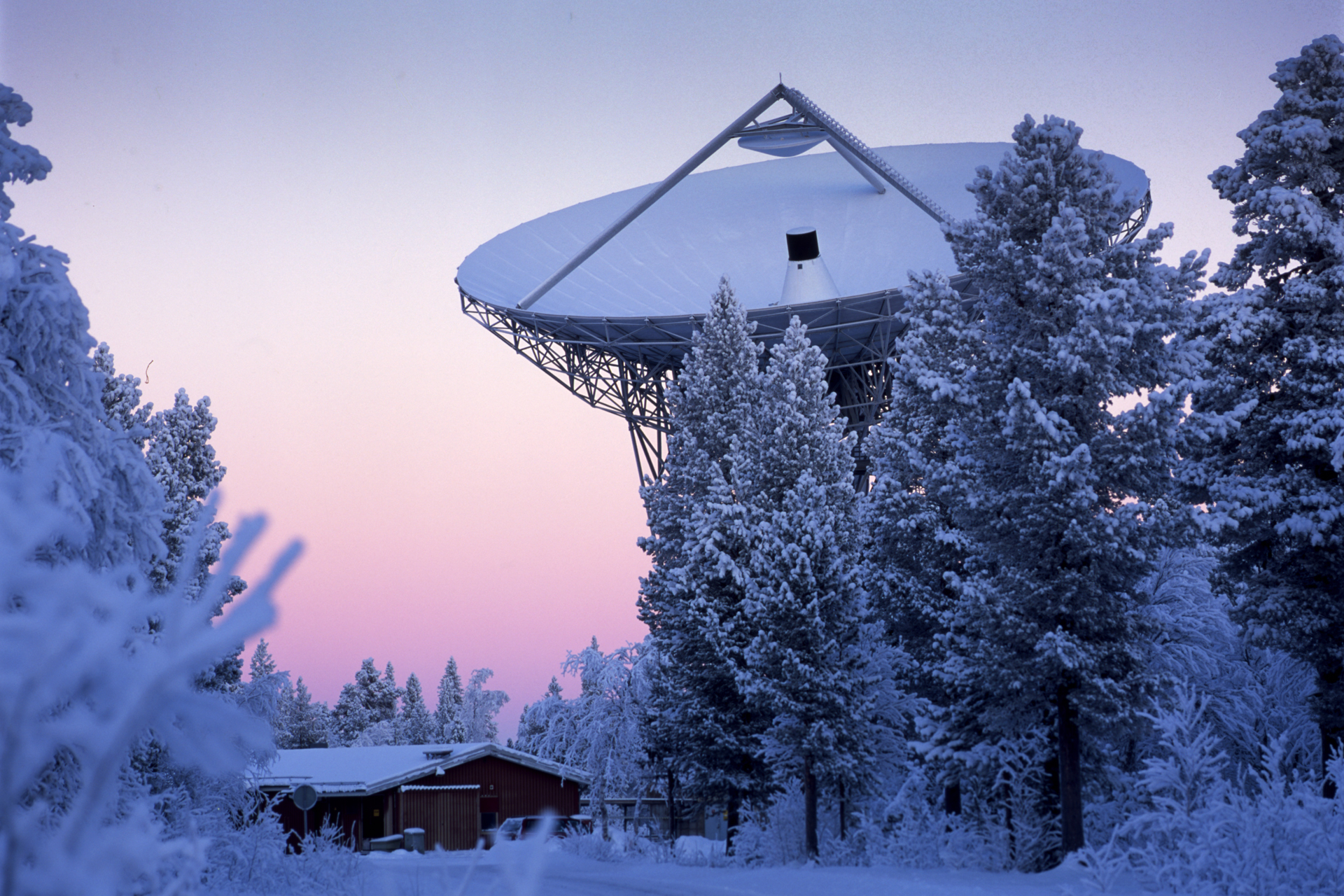
EISCAT Radar dish outside of Kiruna. Credit: Lars-Göran Vanhainen eiscat.se
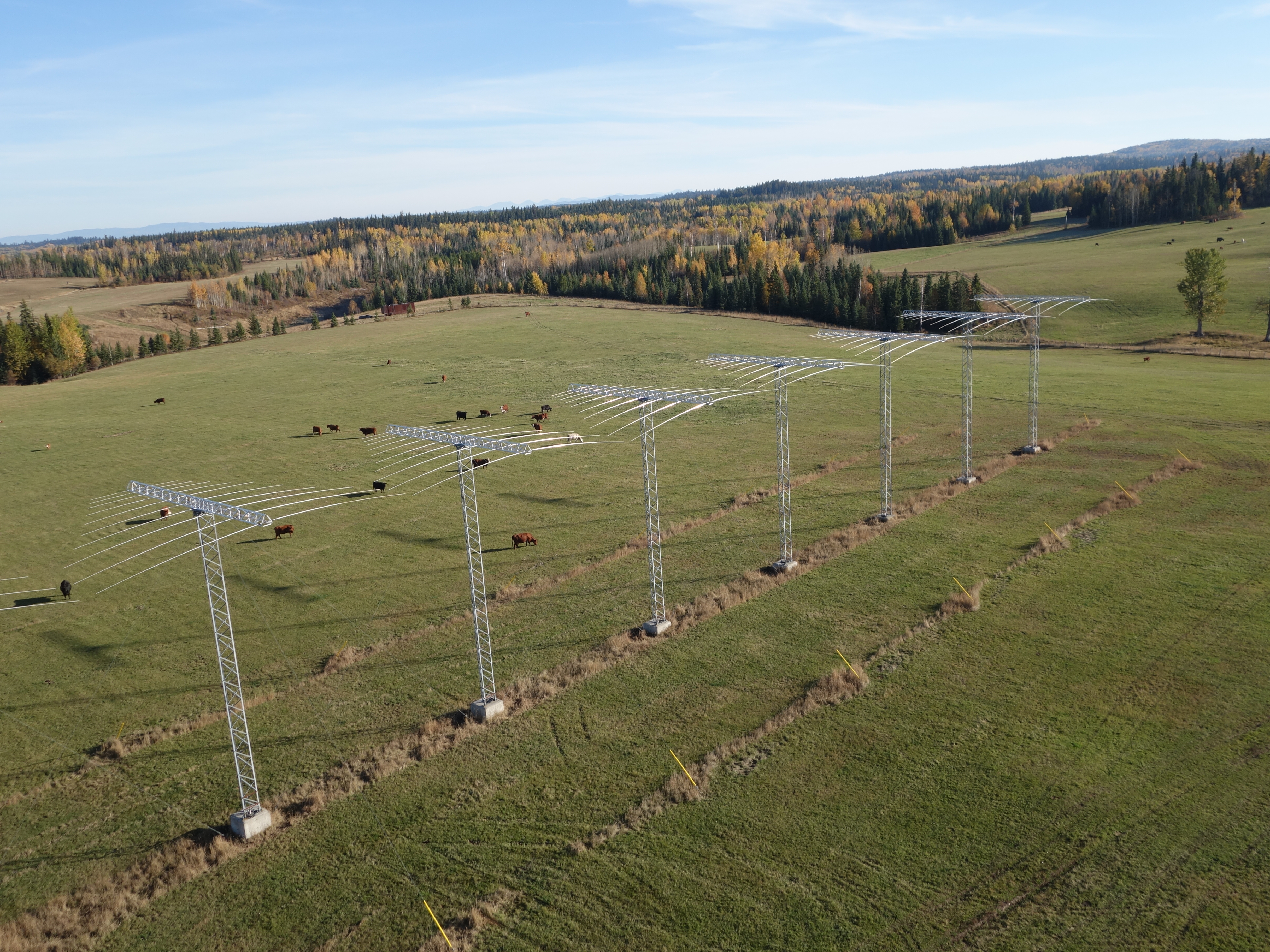
SuperDARN Radar at Prince George, BC, Canada.
Conversely, SuperDARN implements coherent scatter radars. Coherent scatter radars will only see very large amplitude structures that are aligned with the magnetic field. SuperDARN uses refraction to bend the radio waves so that they hit the magnetic field aligned structures at a right angle, or perpendicularly. SuperDARN chooses to use coherent scatter radars due to the benefits to the science and experiment itself. Coherent radars generally have a much lower time and range resolution (~secs, ~10s km) than incoherent (~mins, ~100s m), but can operate at varied frequencies, at much lower power and consider a much large field of view. The set up of SuperDARN only allows for the measurement of velocity along the line of sight (that is along the beam in the field of view, towards or away from the radar). SuperDARN is a global network of radars, with overlapping fields of views that collaborate to calculate the 2-dimensional velocity in the ionosphere.
Magnetic Field
The magnetic field of Earth is very similar to a magnetic field of a bar magnet. The geographic north pole of Earth is a south magnetic pole, this means that the magnetic field lines point downwards towards the Earth when in the high latitude northern regions. In the southern geographic high latitude regions, the opposite is true, the field lines point up and away from the Earth. To join the field lines together this means that at the equator, the field is parallel to the ground. SuperDARN is primarily interested in researching the interaction of the solar wind with the magnetic field of the Earth. This interaction occurs mainly in the mid- to high-latitude regions, as such we are primarily concerned with the magnetic field in these regions, which on average is perpendicular to (coming straight in or out) the Earth's surface.
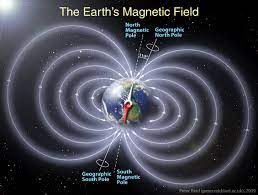
Magnetic field of Earth. Credit: Peter Reid, The University of Edinburgh
Refraction/Reflection - Scattering off Ionospheric Irregularities
The ionospheric anomalies that SuperDARN radars can 'bounce' radio waves off, can be considered irregularities in density of electrons or ions. A sharp change in density of electrons in a volume will change the behaviour of the wave that is travelling through it. Under certain favourable conditions the wave is reflected and returned to the radar. These favourable conditions are met once the radio wave is perpendicular to the magnetic field, and the ionospheric irregularity that is aligned along the field. To do this, we need to consider the Bragg condition.
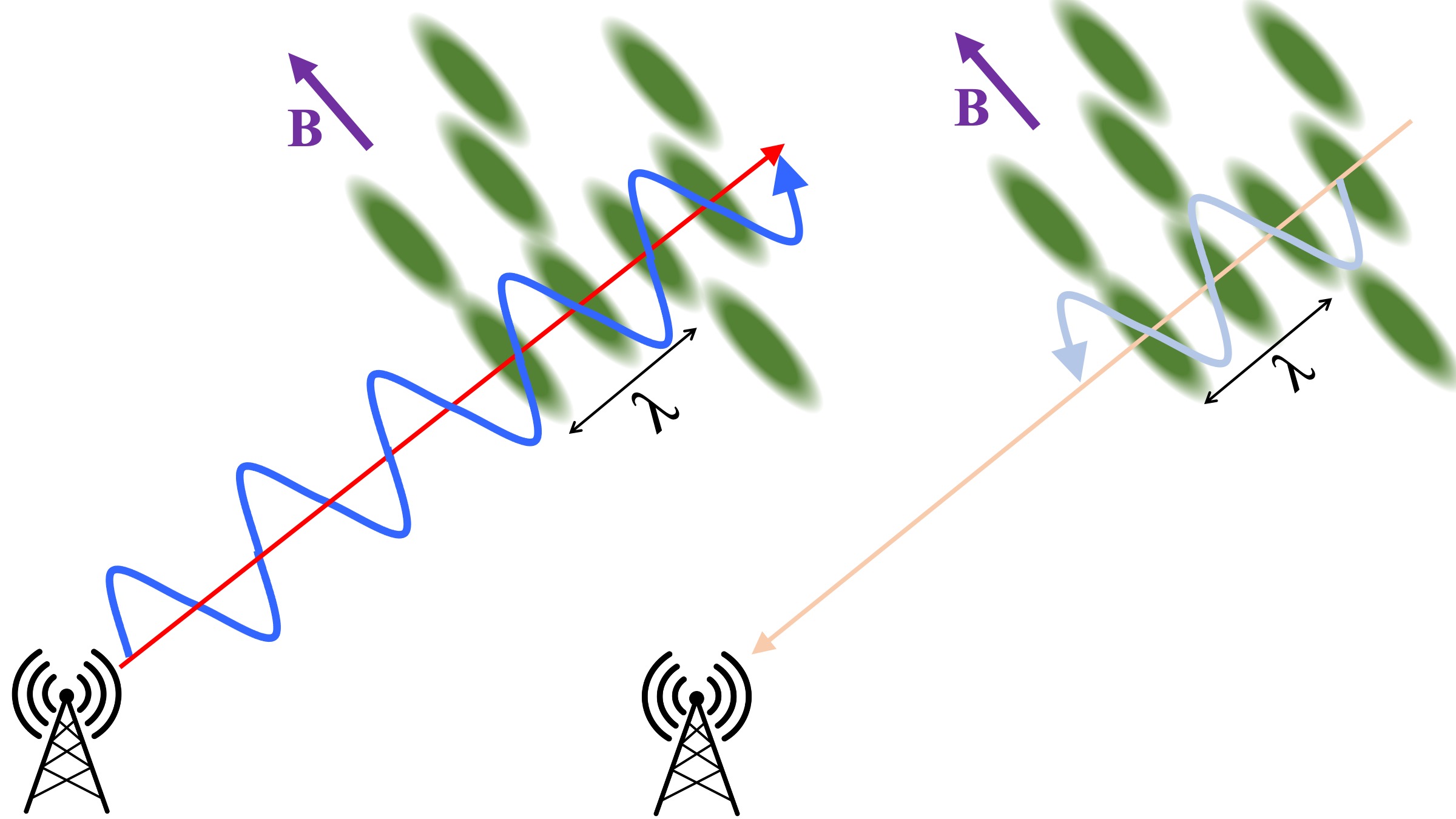
Diagram of how the Brag condition is met with irregularities in the ionosphere.
The Bragg condition is more commonly described in crystal structures. The condition describes where waves travelling through a medium will constructively and destructively interfere with each other. In a crystal, atoms are regularly arranged so that if the atoms are spaced at the same distance as half of the wavelength of the wave that is being directed towards it, the wave will reflect and the returning wave from each atom will be in-phase with each other. Therefore, constructively interfering and a returning wave will be measured. This can tell us all sorts of information about the crystal lattice that we have fired x-rays at.
Now if we scale up to radio wave-lengths, and instead of atoms in a crystal lattice, we consider magnetic field aligned density irregularities in the ionosphere. The same rules apply, but at a much large scale. When irregularities in the ionosphere are found aligned and at a distance from each other of half of the radio wave's wavelength, we get constructive interference and a wave is reflected back towards the receiver which we can measure and gain information about the ionosphere.
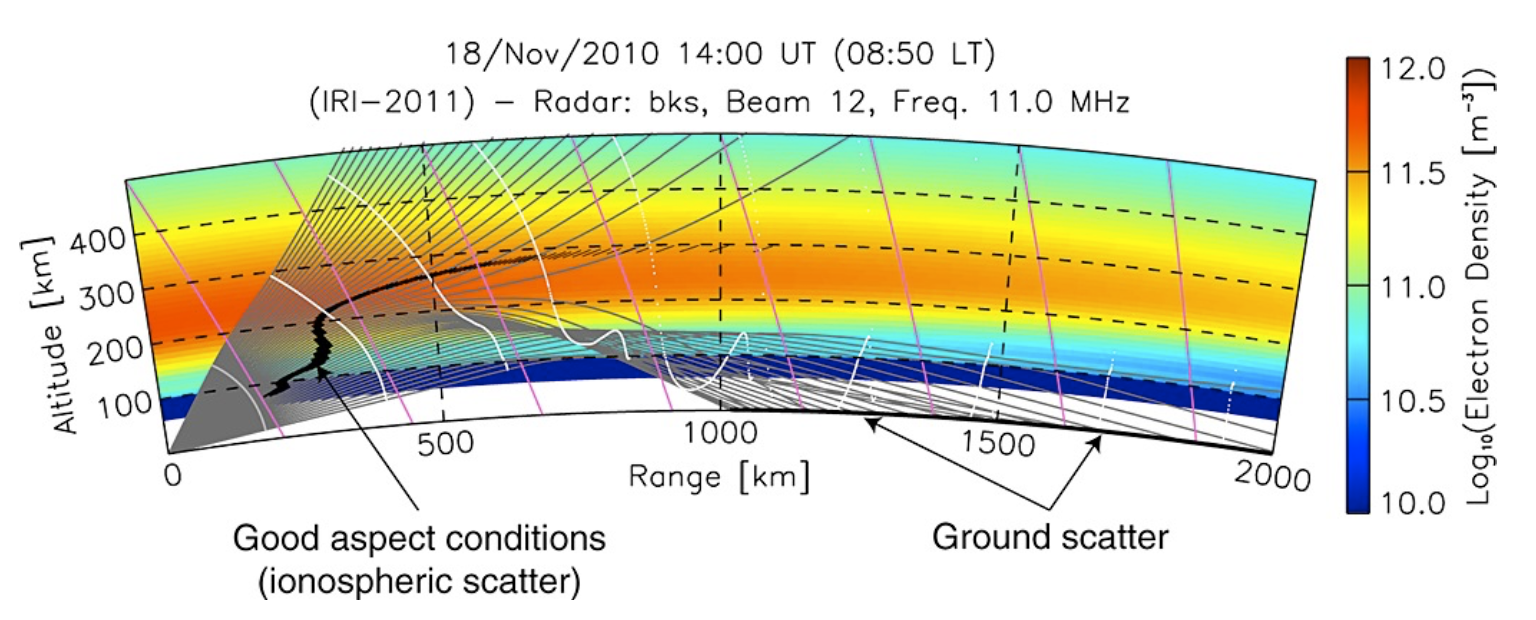
Black shaded areas show where Braggs condition is met and we get good scatter from the ionosphere. From de Larquier et al. (2013)
References and Further Reading